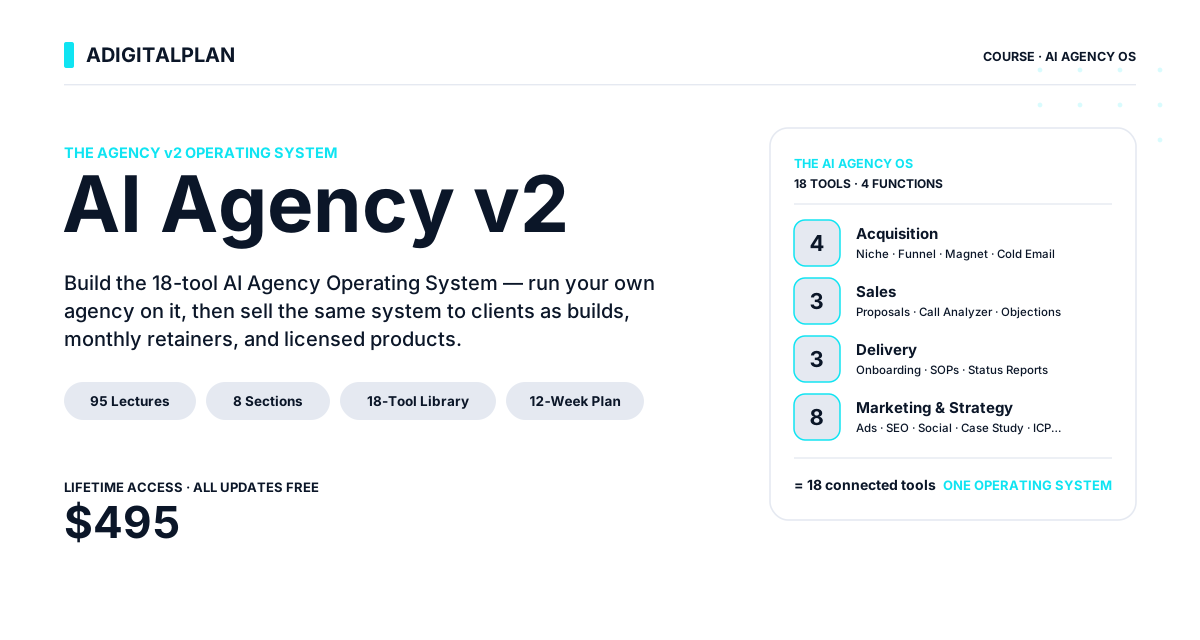
AI Agency v2
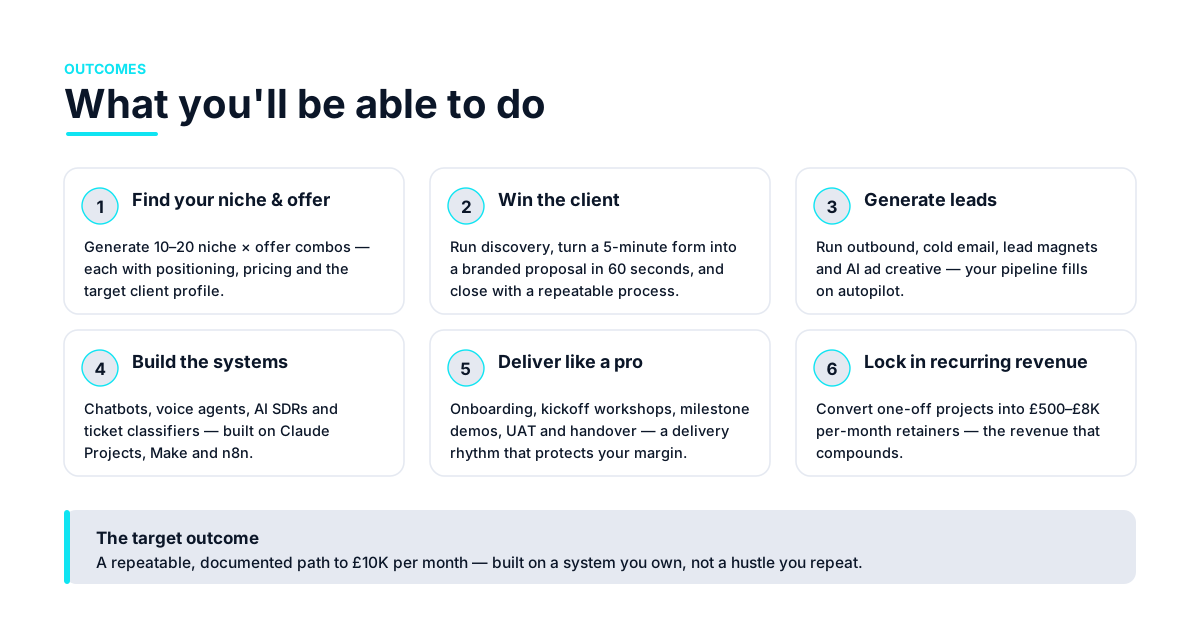
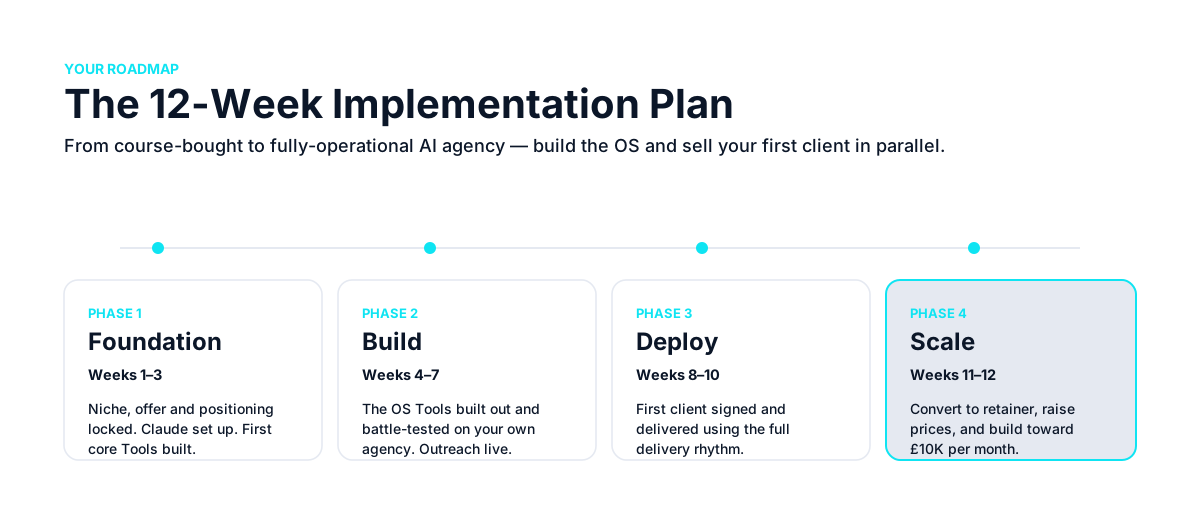
The complete system for starting and scaling an AI agency — 95 lectures, 18 tools, and a 12-week plan to your first £10K month.

Instructor
David Tainsh
Course details
Lectures
:
102
Level
:
Beginner
- Description
- Curriculum
- FAQ
- Reviews
Section 1: Introduction & Foundations
-
1
 1-1 - Introduction to AI Agencies
What an AI agency actually is — the difference between using AI tools and building an AI agency, why the next 24 months are the biggest commercial window agencies have seen in a decade, and how this course turns that opportunity into a deployable system. Sets the framing for everything that follows: Agency v1 (the old model) versus Agency v2 (what you're about to build).
-
2
1-2 - How AI Is Used by Agencies
The four production levers — Conversation, Content, Advertising, and Analytics — that power every modern AI agency service. You'll see what each lever earns (with real pricing), which tools deliver it, and how the 9-tool AI Agency OS maps onto your client lifecycle from acquisition through retention. By the end of this lecture you'll know what you can sell and what each service is worth.
-
3
1-3 - Why AI Deployments Fail
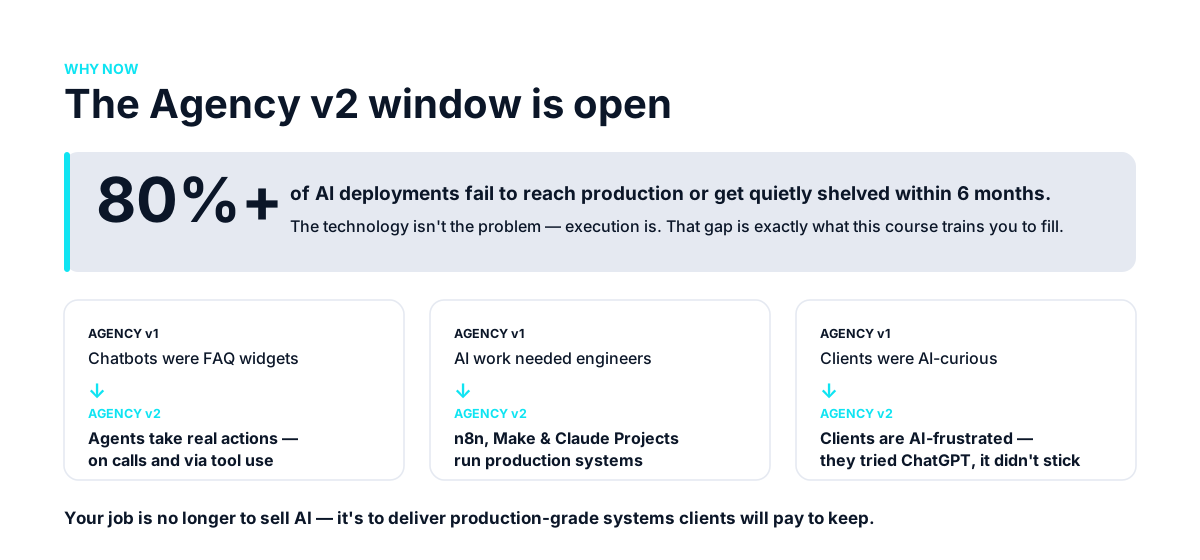
80%+ of AI projects fail to reach production or get quietly shelved within 6 months. This lecture covers the four failure modes that kill them — the Knowledge Gap, the Integration Wall, the Scaling Cliff, and the Ownership Vacuum — with real examples for each. You'll see exactly how Agency v2 makes these failure modes impossible to repeat, which is the through-line for the rest of the course.
-
4
1-4 - The Agency v2 Landscape
Where the money is flowing in AI agency services right now. Which categories are saturated and have seen margins compress, which categories are still wide open with strong demand and weak supply, and how to position your agency to win in the niches that are still under-served. Includes current pricing data and the commercial reality of each service line.
-
5
1-5 - The Agency v2 Stack
The exact tool stack you'll build the course around — Claude for the AI engine, Voiceflow and Vapi for voice and conversation, Make and n8n for automation, Apify and Clay for data, plus the integration points that hold the system together. You'll leave this lecture knowing precisely what to sign up for and why, with budget estimates per tool and a build order that minimises wasted spend.
-
6
1-6 - Solo Operator vs Team Models
The two viable agency operating models in the AI era. The solo operator running £200K-400K from a laptop with the right tool stack, and the lean team scaling to £800K-£1M+ with one or two strategic hires. You'll see the mathematical paths for each model, the trade-offs, the revenue thresholds that trigger the hiring decision, and a framework for deciding which path fits your goals.
Section 2: Agency v2 Services & Pricing
-
7
2-1 - Agency v2 Services
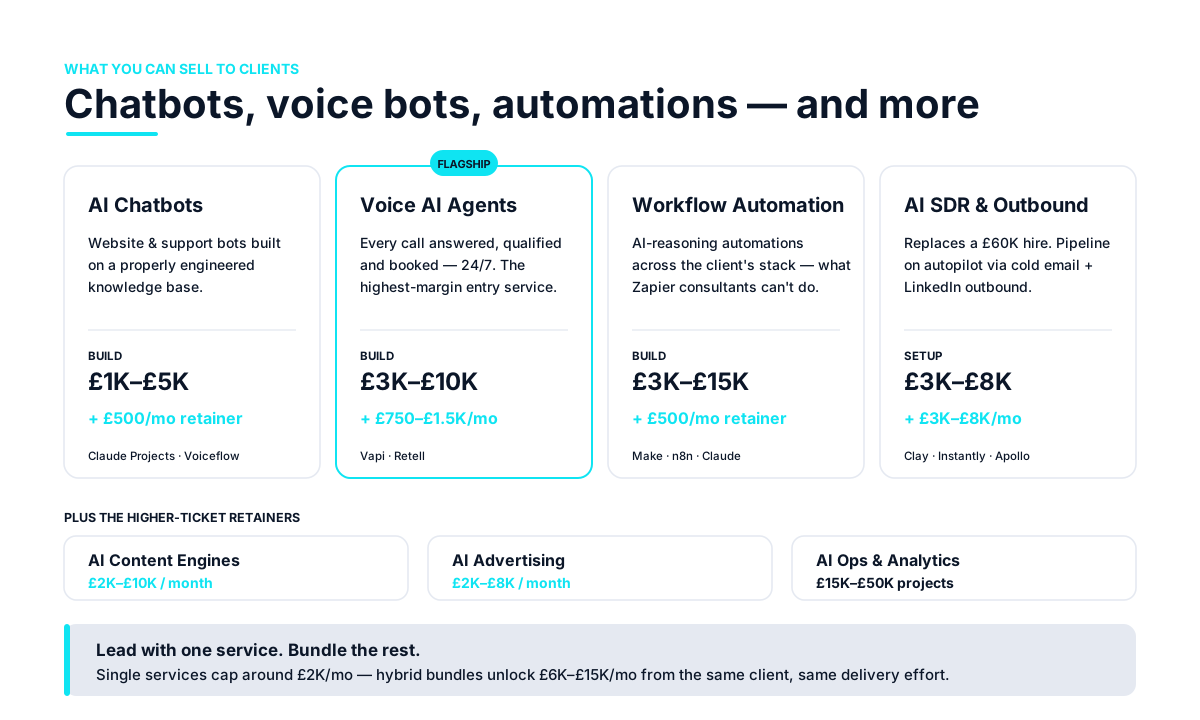
The complete Agency v2 service catalogue: AI Chatbots, Voice AI Agents, AI Content Engines, AI Advertising, AI SDR & Outbound, and AI Ops & Analytics — six categories, each with its own price bands and tech stack. You'll see what every service earns as a build and as a retainer (from £500/mo chatbot upkeep to £15K+/mo ops engagements), which tools power each one (Voiceflow, Vapi, Claude, Clay, n8n), and how the three hybrid bundles — the Inbound Engine, the Outbound Machine, and the AI Operations Stack — turn single services that cap around £2K/mo into £6K–£15K/mo retainers. The through-line: lead with one service, bundle the rest.
-
8
2-2 - Pricing AI Services
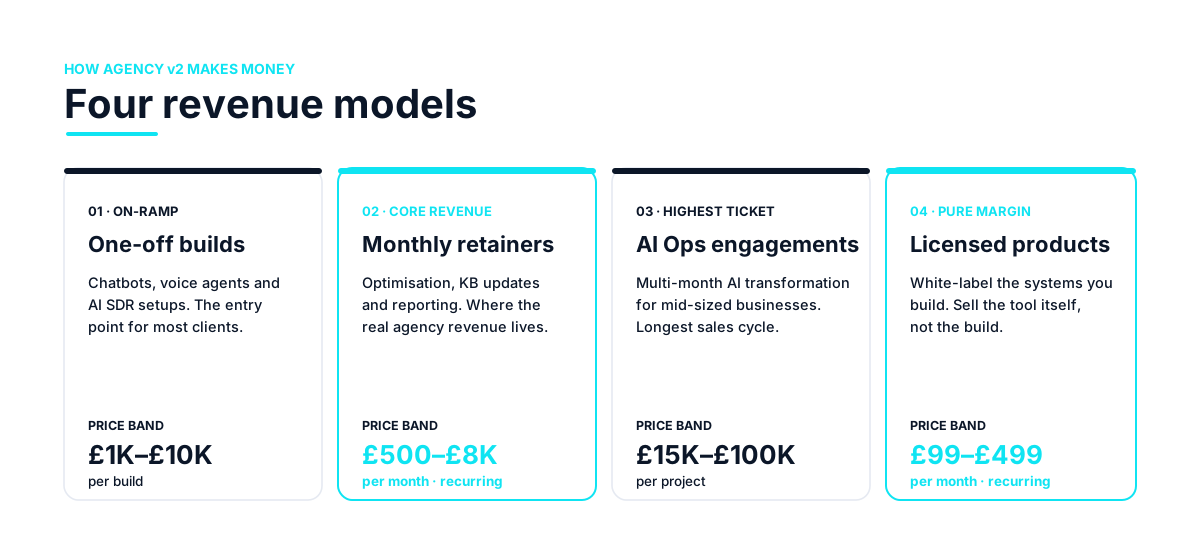
The four pricing models every Agency v2 deal is built from — One-off Build, Monthly Retainer, Usage-Based pass-through, and Licence Fee — and why hourly pricing is the one model that punishes the efficiency this entire business depends on. You'll learn the canonical build-plus-retainer structure (the build funds delivery, the retainer funds the agency), the three-line proposal that neutralises the single biggest margin risk in AI work — runaway LLM token costs — by passing them through at cost +25–30%, and the five pricing mistakes that quietly kill margins, from discounting the build to win the retainer to forgetting the annual price increase.
-
9
2-3 - AI Chatbot Agency Packages
How to turn bespoke chatbot quoting into menu-selling across five niches — Customer-Facing, Sales & Lead Gen, E-commerce, Booking, and Knowledge Base bots — each packaged into three named tiers (Starter / Growth / Custom) so the middle tier wins on price-anchoring. You'll get the real build and retainer numbers per tier (from £1K builds + £500/mo up to £50K+ builds + £8K/mo) and the Chatbot Power Bundle: pairing a standalone bot (which maxes out around £2K/mo) with Proposal Gen, Outreach Builder, and Call Analyzer to triple the same client to £5K–£8K/mo for the same delivery effort.
-
10
2-4 - The AI Agency OS Overview
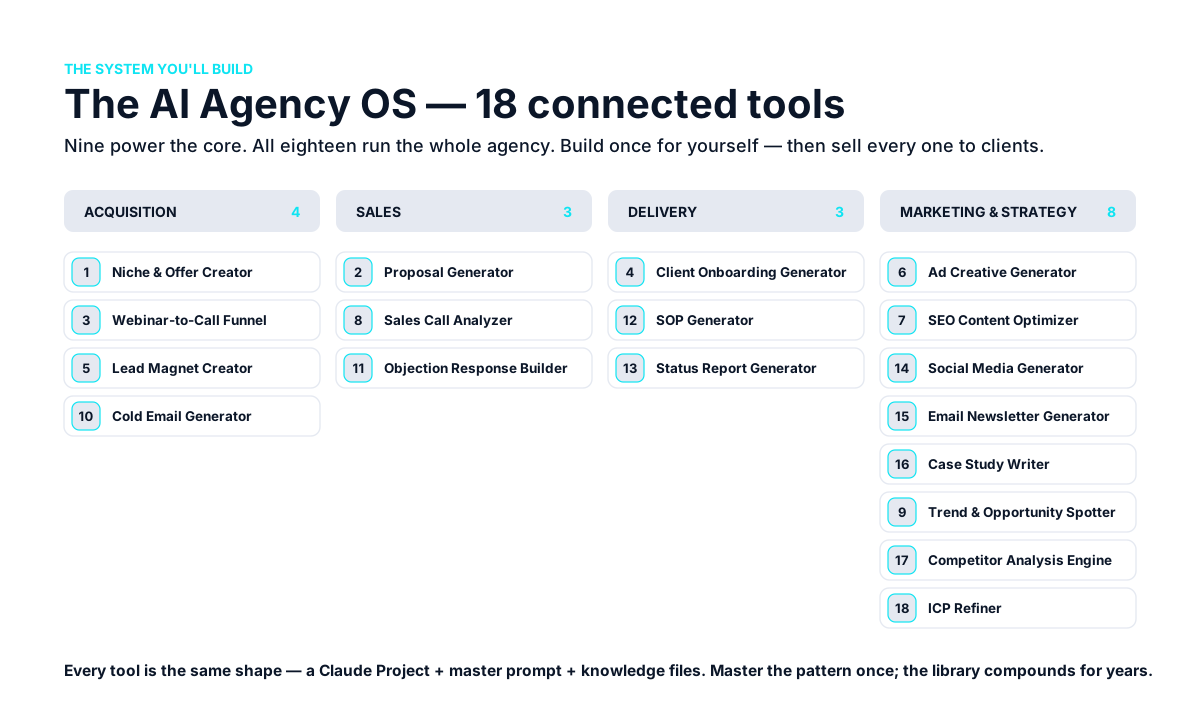
The 9-tool system at the centre of the whole course — what each tool does, how they map onto the agency lifecycle (Find & Sell, Attract & Qualify, Deliver & Grow), and the dual nature that makes them so valuable: you build the OS once, run your own agency on it, then sell the same tools to clients as productised retainers. You'll meet all nine — from the Niche & Offer Creator and Proposal Generator through to the Sales Call Analyzer and Trend & Opportunity Spotter — and see how each is both an internal lever and a white-labellable offer worth £99–£299/month.
-
11
2-5 - Voice AI Agents Service
The highest-margin Tier 1 service, packaged end to end. The five voice use cases you can sell (Inbound Reception, Outbound Qualification, Appointment Reminders, L1 Support, Lapsed-Customer Reactivation) with their ideal-client profiles, the full voice stack one layer at a time (Vapi or Retell for orchestration, Claude for reasoning, ElevenLabs for voice, Twilio for the line, n8n/Make for integrations), and the six-stage build process from discovery to a 30-day tuning sprint. You'll get the canonical three-line deal — £3K–£10K build + £500–£2K/mo retainer + usage at cost +25–30%, roughly £18K in year one — the discovery questions that tell you which tier to quote, and the walk-away signals that flag a bad-fit client before you sign.
-
12
2-6 - AI SDR Service
The B2B retainer that prints pipeline — why it's the easiest high-ticket service to sell (it replaces a £40K–£70K human SDR hire with a £3K–£8K/mo retainer a founder can buy with one signature) and the hardest to switch out once your sequences are warmed up and inboxes are tuned. You'll learn the five jobs of the AI SDR system — prospect sourcing, enrichment, sequencing, reply handling, and meeting booking — the stack behind it (Clay, Apollo, Instantly/Smartlead, Claude, n8n), and the setup-plus-retainer pricing that makes outbound a recurring, measurable, renew-on-results line of business.
-
13
2-7 - AI Ops & Analytics Service
The most consultative — and highest-ticket — service in the catalogue, structured as a three-stage ladder: Audit → Implementation → Retainer. You'll see why the £2K–£5K audit is a real 30–50 page product rather than a sales tool dressed up as a deliverable, how pricing it low enough to make "no" feel silly qualifies out tyre-kickers while converting 60%+ into £15K–£50K implementation projects, and how those land into £2K–£10K/mo optimisation retainers with predictive dashboards built on Claude + Looker Studio. The frame that makes it work: sell clarity first, implementation second, retainer forever.
-
14
2-8 - Vertical AI Products
The product play that escapes the time-for-money trap entirely — build one tool for one niche, license it 100 times. You'll see the five productisable shapes (Niche Receptionist, Lead Qualifier, Industry Content Engine, Vertical Dashboard, Compliance AI), the extra infrastructure that turns a service into a SaaS-like product (Stripe/Lemon Squeezy billing, a Framer/Webflow storefront, self-serve onboarding, AI-handled support), and the validation gate that kills bad ideas before you write a line of code: 10 customer conversations and 3 pre-orders first. The maths that closes the section: 100 customers × £199/mo = £20K MRR = £240K ARR with no per-client delivery — and an asset that actually sells at exit.
Section 3: Client Acquisition
-
15
3-1 - Client Acquisition Chatbots
Why a chatbot build is the perfect wedge offer — small enough for a prospect to say yes fast (a £1.5–3K build feels like a trial commitment, and most are never put out to tender), big enough that once it's live and answering enquiries within 14–21 days you become indispensable. You'll see the four reasons it works — low barrier to the first "yes," immediate visible value, the natural upsell into a £500–2K/mo knowledge-base retainer with no separate sale, and the way being inside a client's stack surfaces five more automation opportunities — which is what makes the chatbot the front door to a £5K+/mo relationship rather than a one-off project.
-
16
3-2 - Customer Acquisition via Content Audits
The audit funnel that turns a free report into your sales engine, run two ways off the same infrastructure: an embedded white-label widget for inbound, and bulk-audited prospect lists for outbound. You'll set the whole thing up in a weekend — SEOptimer at $19/mo for the white-label PDF, a Zapier-to-CRM connection, a 5-email nurture, and a Calendly link on the report cover — and learn why personalised audit outreach pulls 5–15% replies against 1–2% on generic cold email. The frame that makes it pay: don't give the audit away then re-scope, position the retainer as "we fix what the audit found," so month one is already pre-sold.
-
17
3-3 - Content Briefs and Plans for High-Value Clients
The wedge for enterprise — why £10K+/mo buyers don't respond to ads but do respond to thinking, and how a 15–50 page niche-specific strategy brief proves competence better than any sales call. You'll learn to use AI to produce in ~4 hours what used to take two weeks, why depth beats reach for this audience (aim for 200 downloads from your exact ICP, not 10,000 random ones), and the quarterly cadence that turns one brief into an inbound authority machine. Ship one every 90 days or don't bother — cadence is what makes it a system rather than a piece of content.
-
18
3-4 - Webinar-to-Call Funnel
The wedge for enterprise — why £10K+/mo buyers don't respond to ads but do respond to thinking, and how a 15–50 page niche-specific strategy brief proves competence better than any sales call. You'll learn to use AI to produce in ~4 hours what used to take two weeks, why depth beats reach for this audience (aim for 200 downloads from your exact ICP, not 10,000 random ones), and the quarterly cadence that turns one brief into an inbound authority machine. Ship one every 90 days or don't bother — cadence is what makes it a system rather than a piece of content.
-
19
3-5 - Paid SEO for Intent Traffic
How to capture buyers actively Googling "AI chatbot agency UK" — the highest-converting traffic an agency can buy — and why 20 clicks from a buyer-intent term beats 2,000 from "AI tools." You'll learn the discipline that makes it work: one dedicated single-CTA landing page per ad group (generic homepages convert intent traffic at a fifth of the rate), and speed-to-lead as the whole game — calling a lead within 5 minutes versus 60 triples conversion, automated via Tool 3. Best run alongside organic SEO on the same keywords so you own both the paid and organic positions on the page.
-
20
3-6 - Google Ads for Intent Searches
The tactical execution layer for intent traffic inside Google Ads specifically — live in a day where organic SEO takes 6–12 months. You'll get the account structure that lets the algorithm learn fast (campaigns per service line, ad groups per intent cluster, 5–15 tightly-themed phrase/exact keywords, 3–5 ad variants, every extension), the 3-headline/2-description copy formula, the bid-strategy ladder matched to data maturity (Manual CPC weeks 1–4 → Max Clicks → Target CPA at 30+ conversions), the five conversion events to track from day one, and the negative-keyword starter list that stops budget bleed. Structure first, bids second — bidding never fixes a bad structure.
-
21
3-7 - Social Media Advertising for AI Content
Paid social as the fastest way to put your audits, briefs, and demos in front of cold audiences that the asset itself warms up — at a predictable £8–25 per email captured. You'll learn the Meta-vs-LinkedIn decision (Meta £3–15/lead for B2C and small-biz; LinkedIn £20–80/lead for B2B mid-market, with document ads and thought-leader formats), which five content offers convert best behind the lead form, and why you promote the asset — never the service — then let the follow-up sequence sell. Build all six audiences upfront and hold the budget six weeks before judging; the algorithm needs conversion data to optimise.
-
22
3-8 - Social Media Advertising for AI Chatbots
The same paid-social playbook tuned for chatbots — the most visual AI service, demo-able in 15 seconds, which makes it disproportionately good on Meta and LinkedIn. You'll get the four niche ad templates (support, lead-qual, booking, e-com advisor), the five-element creative formula layered with the demo-as-proof element, and the rule that separates winners from losers: one campaign per niche, never a combined "chatbot" campaign, each with its own creative, landing page, and bid strategy. The CTA is "see the demo," not "book a call" (3–5× more clicks), and the retargeting layer carries ~90% of the pipeline — non-negotiable from day one.
-
23
3-9 - AI Chatbot Advertising Templates
A swipe-and-customise creative library across Meta, LinkedIn, Reddit, and Google for every chatbot niche — launch an ad in 15 minutes instead of 2+ hours. You'll get the platform-specific templates with character counts and structure (Meta video-carousel, LinkedIn single-image/document, Reddit native-tone promoted post, Google responsive search), the five visual assets to produce per niche (demo video, chat screenshot, document ad, carousel, founder selfie video), and the five template mistakes that turn shortcuts into bad ads — from shipping with literal [BRACKETS] still in the copy to reusing one niche's demo on another. Each platform has its own voice; the structure stays, the inputs change.
-
24
3-10 - AI Workflow Automation Adverts
The same paid playbook applied to the highest-margin, lowest-competition service in the catalogue — and why boring problems get budget approval that sexy ones don't. You'll learn the five specific workflows that resonate (lead intake, invoice chasing, onboarding, reporting, ticket routing), the six operations-heavy buyer profiles to target by role title rather than "business owners," and the analytical ad-copy formula built on a named workflow, hours-saved-per-week, the tool stack (Make + Claude + their CRM), and a build-cost-plus-timeline anchor. The wedge is a free 30-minute workflow audit that converts to a project 30–50% of the time — sell the workflow, not the AI.
-
25
3-11 - LinkedIn Outbound with Dripify and AI
How to send 200 personalised LinkedIn messages a week — automated, on-brand, without sounding like a bot — by splitting the work: Dripify sends, Claude personalises. You'll wire the full ~£200/mo stack (Sales Navigator → Dripify → Apify scraper → Claude API → n8n), run the six-move AI personalisation layer that lifts reply rates 3–5×, follow the 5-step 14-day sequence (profile visit → connection → value message → soft pitch → breakup), and handle the five reply types correctly. The guardrails matter: warm new accounts 2–3 weeks, cap at 20–25 invites/day, and never automate replies — that's where the close lives.
-
26
3-12 - Building an AI SDR for Your Own Agency
Eat your own dog food — build the exact Clay + Instantly + Claude SDR you sell to clients and point it at your own pipeline first, so you become the case study ("we book 30 meetings/month with this system"). You'll define your own ICP across six fields before prospecting anyone, stand up the same five-layer stack from the 2-6 service lecture, run the 4-email 14-day sequence (reply-rate target 8–15%), and follow the 8-step setup that takes 2–3 weeks of infrastructure and warm-up before the first send. Running it yourself battle-tests every workflow gap before you sell it — and one closed deal covers 12+ months of the £200–400/mo system cost.
-
27
3-13 - AI Cold Email at Scale
The deep dive on sending 5,000+ personalised cold emails a month without burning your domain — the only channel that truly scales past LinkedIn's 25-invites-a-day cap. You'll build the five-tool infrastructure stack (Instantly/Smartlead, lookalike sender domains, Clay enrichment, Claude personalisation, a Claude+n8n reply classifier), nail the domain-and-inbox foundation (never the main domain, 3–5 inboxes each, SPF/DKIM/DMARC, 2–3 weeks warm-up, 9+/10 on mail-tester), and run the 5-email 21-day sequence. The order is the lesson: infrastructure first (70% of success), copy second, volume last — and at scale, Claude-classified reply handling is the only way to keep up with 200+ replies a month.
-
28
3-14 - The Demo as Lead Magnet Strategy
Why a free niche AI tool converts at 3–5× the rate of any ebook or whitepaper — the prospect is inside your product feeling the value, not skimming a PDF. You'll learn to build and ship a niche-specific tool in two weeks ("AI quote builder for plumbers" has no competition; "AI tool for everyone" competes with ChatGPT), let users get value 1–3 times before you ask for an email, track heavy and repeat users as hot leads, and reach out personally to the top 5% — which is where the £5K+ deals come from. Niche-specific and leading somewhere is what separates a lead magnet from a toy.
-
29
3-15 - YouTube as a Lead Source for AI Agencies
The highest-trust, longest-half-life channel for B2B AI agencies — slowest to start, compounds for years once live, because a 15-minute build video is 100× the proof of any tagline. You'll learn the five video formats that convert (build-in-public tutorials, tool comparisons, case-study breakdowns, niche deep-dives, live build streams), the weekly publishing SOP that runs on VidIQ + Descript + Opus Clip, and the repurposing model that turns one video into six assets. Months 1–3 are pure investment at ~10 views a video — quitting then is the only way to fail; niche down and survive to the compounding.
-
30
3-16 - LinkedIn Personal Brand as Inbound
The same compounding logic as YouTube but on LinkedIn, exploiting one asymmetry: personal posts get 5–10× the reach of company-page posts, because people follow people, not logos. You'll get the five post formats that convert, the weekly SOP (optimise the profile as your landing page, batch-write five Claude-assisted posts, schedule with Taplio, then 20 minutes of daily ICP engagement), and the five mistakes that suppress reach — posting from the company page, generic "AI revolution" thought leadership, external links in the post body, posting and ghosting. Specificity beats thought leadership: one client, one number, one moment — and engagement is the second half of the job, not optional.
-
31
3-17 - Partner and Referral Channels
The lowest-CAC, highest-close-rate, warmest channel most AI agencies ignore while obsessing over outbound and ads. You'll learn the six partner types to build over 12 months (web agencies, marketers, coaches, accountants, software resellers, industry associations), the reciprocity rule that keeps partnerships alive (refer first, before you ask), the 1-page partner agreement, and the monthly activation system — because signed partners send zero referrals unless you activate them with regular outreach, quarterly co-webinars, and fast payment. Build it after you have clients to refer, and it becomes a compounding pipeline that costs nothing.
-
32
3-18 - Niche Community Marketing
Where your buyers actually talk to each other — Slack groups, Skool communities, subreddits, Indie Hackers, newsletter Discords — and how to become the go-to AI person for a niche without getting banned. You'll learn which five community types produce leads, the give-before-take rule (20:1 helpful-to-promotional minimum, lurk 30 days, never cold-DM), the daily 20-minute engagement workflow, the five thread types that signal buying intent ("has anyone used…", "looking for recommendations…"), and the slow-but-deep conversion path where a community recommendation closes at 70%+. Be useful for 6–12 months and you inherit the community's trust permanently.
-
33
3-19 - Creating AI Chatbot Products
How to escape custom-build margins (30–50%) by productising chatbots into a three-tier ladder — Starter £499–999, Growth £1,999–3,999, Enterprise £8K+ — at 70–80% margins on the same revenue. You'll learn the five criteria an offer must hit to be productisable (repeatable use case, fixed scope, standard integrations only, defined timeline, template-able KB), the standard 14-day six-stage delivery template that kills improvisation, and the pricing psychology that maximises conversion and margin. Most agencies should sell mostly Tier 2 — build a ladder, not a single product.
-
34
3-20 - Getting to £10K per Month
The synthesis lecture that combines every Section 3 channel into a predictable £10K/month agency in 90 days. You'll see the four realistic revenue mixes that all reach the milestone (5×£2K retainers, 3×£3.5K, one anchor client + four starters, or 10 productised £999 sales), the three 30-day sprints that add one channel at a time (outbound → inbound asset → productise & scale), the correct launch sequence (outbound first because it funds everything, content and partners last), the six reasons retainers are the whole game (≈18× the LTV of one-off builds), the five leading indicators to track every Monday, and the five traps that keep agencies stuck under £10K. It's a system, not a sprint — pick two channels, sell £2K+ retainers, compound for 90 days.
Section 4 — Pitching & Closing AI Clients
-
35
4.1 — Client Pitching Process
The map for the whole section: the six-stage pipeline every AI deal moves through (Lead → Qualified → Discovery → Proposal Sent → Negotiation → Closed) and the conversion target for each transition, so you can diagnose exactly where deals die. You'll get the healthy benchmarks (Lead→Qualified 30–50%, Qualified→Discovery 60–80%, Discovery→Proposal 70–90%, Proposal→Negotiation 50–70%, Negotiation→Closed 60–80%, and 5–15% lead-to-close overall), the diagnostic for what's broken when you fall below each, the ~£60/mo CRM stack (Pipedrive as default), the six Monday-morning CRM checks, and the eight-task weekly pipeline rhythm. The through-line: pipeline is a system, not a funnel — and speed (reply within 4 hours, proposal within 24, follow-up within 48) separates a 5% close rate from a 20% one.
-
36
4.2 — First Meeting and Discovery Call
The single most important sales skill, because discovery is the sale — a great proposal can't rescue a bad discovery. You'll get the 30-minute six-block structure (Rapport 0–3, Context 3–10, Pain 10–18, Constraints 18–22, Fit 22–27, Next Steps 27–30), the five questions that write the proposal for you (walk me through today / success in 6 months / what's failed before / what changes if we deliver in 30 days / who else decides), and the five pain-elicitation phrases that drill three layers past the surface answer to the real, quantified pain. Plus the five walk-away signals (guarantee-seekers, three prior failed vendors, budget 5× below your minimum, decision-maker absent, NDA before discovery), the eight-field note template that feeds the Proposal Generator, and the discovery SOP. The principle: listen 80%, ask five great questions, lock the next step — the proposal is just paperwork.
-
37
4.3 — The Audit-to-Proposal Bridge
How to stop leaving half your audit pipeline on the table by deliberately converting Section 3's free audits into Section 4's £5K+ proposals. The core insight: a good audit already surfaces pain, scope, and urgency, so it's done ~70% of the discovery for free — which is why an audit-walkthrough call closes at roughly 2× the rate of a cold discovery. You'll learn to run the audit as the agenda (not a sales prop), walk the findings, and bridge straight from "here's what's broken" to "here's the engagement that fixes it" — the move that turns downloaded-and-forgotten lead magnets into signed contracts.
-
38
4.4 — AI Chatbot Proposal Walkthrough
The anatomy of the chatbot proposal across three tiers — £1K, £5K, £100K — that all share one locked nine-section structure (Cover, Objective, Scope, Cost, Timeline, Deliverables, Terms, Next Steps, Sign-off); only the depth inside each section scales. You'll learn the five discovery signals that tell you which tier to send in a 30-second judgement call (company size, number of use cases, integration depth, decision-maker context, budget hints), what each tier actually includes (Tier 1 basic/5 phases/10 days, Tier 2 the £5K sweet spot/6 weeks, Tier 3 enterprise/7 phases), and the five proposal mistakes that lose deals at every tier (wrong tier sent, vague scope, no outcome in the objective, hidden ongoing costs, no time-bound next step). The principle: structure is locked, tier is judgement — and the Proposal Generator writes whichever tier you choose.
-
39
4.5 — AI Automation Proposal Walkthrough
The same nine-section anatomy, re-pointed for workflow automation, where the economics work differently and under-quoting is the main risk. You'll learn to anchor every quote in hours saved (12 hrs/week × £30/hr × 52 = £18,720/year), to price by workflow count as if they were products (1 workflow → £3K, 3–5 → £10K, 8–15 → £25K), to charge for integration complexity (5 systems × 5 = 25 integration points), and to attach a 4–12-week maintenance retainer to every deal because workflows break when tools update. Plus the three tiers (£3K single / £10K multi / £25K enterprise with a mandatory 2-week audit phase) and the five mistakes (no hours-saved maths, forgetting the retainer, listing too many tools, skipping the Tier-3 audit). The through-line: workflows are products — count them, price them, ship them, and never sell pure one-off.
-
40
4.6 — AI SDR Proposal Walkthrough
The build-plus-retainer hybrid, which needs a different proposal shape — two cost tables, not one: a one-off setup fee plus a recurring monthly retainer (total deal value = setup + monthly × 12). You'll learn why the infrastructure has to be visible (domains, inboxes, warm-up justify the setup price), why the minimum term must be locked in Terms (3–6 months or you eat the setup and churn at month 2), and how the monthly reporting cadence is what sells the retainer to their finance team. Plus the three tiers (Starter £2K/mo + £1.5K setup: 1 ICP, 1 sequence, 5 inboxes; Standard £3.5K/mo + £2.5K setup: 2 ICPs + LinkedIn, 10 inboxes; Enterprise £5K/mo + £5K setup), the rule that volume target picks the tier (20 meetings/mo = Tier 1, 50 = Tier 2, 100+ = Tier 3), and the five margin-killers — chief among them under-pricing the setup and bundling LinkedIn into Tier 1. The principle: promise activity, never outcomes, and lock the term.
-
41
4.7 — Voice AI Proposal Walkthrough
Voice looks like a chatbot proposal but isn't — the hidden cost is tuning. You'll learn to quote voice tuning as its own named phase (it adds 2–3 weeks of accent, pacing, and edge-case work), to surface real monthly running costs in Terms (phone numbers at £10–50/mo each, Vapi minutes, transcription) so there are no post-sign surprises, to scope escalation logic explicitly (transfer / message / voicemail is ~30% of the build), and — above all — to demo before you quote, because buyers can't imagine voice AI from text. Plus the three tiers (£5K reception / £10K standard / £20K enterprise multi-language). The through-line: voice AI sells from the ear, not the proposal — build a quick demo, let them call it, then quote.
-
42
4.8 — AI Ops Proposal Walkthrough
The deepest engagement model in the catalogue, structured as a three-stage ladder of separate proposals rather than tiers: a standalone £3K audit (the wedge), a £15K implementation whose scope is literally the audit's top findings, and a £5K/mo strategic retainer for optimisation, governance, and new-opportunity identification. You'll learn the mechanic that makes it convert — crediting the £3K audit fee against the implementation lifts ladder conversion from ~30% to ~60% — and how the same nine-section anatomy reads completely differently at each stage (audit = consultative, implementation = delivery, retainer = governance). The maths that closes it: £3K + £15K = £18K one-off, but the retainer adds £60K+/year, so you sell the ladder to lock the recurring revenue.
-
43
4.9 — The Proposal Generator (Claude Project · Tool 2)
The build lecture for the tool you've been working toward: a single Claude Project that takes your eight-field discovery notes and returns a branded, on-voice, nine-section proposal in about 90 seconds, having auto-detected the service and recommended the tier with reasoning. You'll get the full setup (create the Project, paste the master system prompt, upload the five service prompts plus your pricing matrix, 3–5 reference proposals, and brand-voice guide as Knowledge Files), the prerequisites (Claude Pro at £20/mo, master-prompt doc, pricing, references), the five verification checks to run before using it on a real client, the 10-minute branded-Google-Doc-to-PDF export workflow, and the quarterly maintenance routine. The point: proposal writing drops from 4 hours to ~20 minutes, so discovery quality — not writing time — becomes the only bottleneck. (The pricing matrix and reference proposals are the killer files; skip them and you get generic AI slop.)
-
44
4.10 — Handling 'We Already Tried ChatGPT'
The #1 objection of 2026 — roughly half of all prospects raise it, and handling it well is what separates closers from chasers. You'll learn why it surfaces (it's the polite "no" for non-buyers — ~70% are testing your reaction, not rejecting AI — and their answer to "what did you try?" is a maturity diagnostic, not a dismissal), the five forms it takes (didn't work / we use it internally / IT built something / why not use it directly [the price form] / and more), each needing a different surgical response. The core move: reframe, don't argue — ChatGPT is the engine, you build the car — then prove it with a live demo showing ChatGPT failing on their data beside your production Claude system working. Demos win where words fail; a well-handled rebuttal roughly doubles the close rate.
-
45
4.11 — Pilot Project Structures
The £2K-pilot-to-£10K-rollout mechanic — a closing move, not a smaller version of the work — that converts at 70–80% versus far lower for direct proposals. You'll learn the five buyer signals that mean "pilot first" (sceptical-but-interested, multi-stakeholder approval, first-time AI buyer, unclear technical fit, an incumbent vendor in place), the six-stage three-week structure (Week 0 discovery + 1-page agreement, Week 1 single-workflow build, Week 2 test + one iteration, Week 3 demo + rollout proposal in the same meeting, 7-day decision window, sign + credit), and three pricing models (fixed-fee £2–3K 100% credited, hourly £150–200/hr capped at 20 hrs 50% credited, audit-pilot hybrid for Ops). The decisive detail: "£2K credited toward rollout if signed in 7 days" takes conversion from ~30% to 70%+ — and the rollout proposal must be printed and ready to sign at the demo, because pilot momentum decays in days.
-
46
4.12 — Sales Call Analyzer (Claude Project · Tool 8)
The post-call automation that pairs with the Proposal Generator: paste a raw call transcript and get five outputs in 60 seconds — a call summary, the eight-field discovery template, objections raised (with how each was handled), next steps committed with dates, and a drafted follow-up email in your voice. You'll get the master prompt, the six-step setup (create the Project, paste the prompt, upload your follow-up-email style guide and the discovery template, test on a past call, wire up Fathom/Otter recording), and the five mistakes that produce bad extraction (partial transcripts, no speaker labels, skipping the style guide, sending the draft blind, copying the internal summary to the client). Together with Tool 2 this is the closing engine — it collapses four hours of post-call work into about 30 minutes, turning every discovery into call → analysis → follow-up + proposal sent the same day.
-
47
4.13 — Lost Deal Analysis and Reactivation
The pipeline you've already paid for but never collected — lost deals are 10–20% of your pipeline and your warmest re-entry point, because the prospect already went through discovery and saw a proposal. You'll learn why ~70% of closed-lost deals had a fixable reason (timing, budget cycle, internal politics) that changes within months, the five loss categories with their realistic recovery rates (timing 30–40%, budget 20–30% at fiscal-year start, competitor 10–20% within 18 months as the incumbent relationship sours, plus the unrecoverable ones), and the quarterly post-mortem that turns individual losses (noise) into patterns (signal) — if 40% cite "too expensive," that's a positioning problem, not ten separate ones. The cadence, run on near-zero CAC (one email versus £300–900 for a fresh lead), recovers 10–20% of lost pipeline.
-
48
AI Set Up : Building the AI Proposal Generator in Claude
A hands-on demo: set up a Claude Project that turns discovery notes into a complete, branded proposal. It detects which of your five core services the deal is, recommends a price tier, and writes all nine proposal sections in about 90 seconds — so you can quote any service in minutes instead of hours.
-
49
AI Set Up : Building the Sales Call Analyzer in Claude
A hands-on demo: set up a Claude Project that turns a raw call transcript into a five-part post-call pack — call summary, objections, next steps, a follow-up email in your brand voice, and ready-to-paste CRM notes. It cuts post-call admin from two hours to ten minutes, and its discovery template feeds straight into the Proposal Generator.
Section 5 — Delivery Operations
-
50
5.1 - The Delivery Operating Rhythm
The mental model for the whole section: the six-phase delivery framework from signed contract to locked retainer — Onboarding (Days 1–7), Kickoff Workshop (Day 7–10), Build (Weeks 2–N), Demos & UAT (final 2 weeks), Handover (final week), Retainer Conversion (Day 60–90, into a £2–5K/mo retainer). You'll learn how the same six phases stretch to project size (£1–3K = 3 weeks, £5–10K = 6 weeks, £15–25K = 12 weeks, £25–100K = 16 weeks), the five-part "operating layer" that runs in parallel across every project (Friday status update, daily PM-stack update, 4-hour comms SLA, scope-creep watch, retainer-signal tracking), and the eight-step weekly rhythm SOP. The five mistakes that break delivery: no kickoff, comms drift, saying yes to creep (140% of scope for 100% of fee), no demo gates, and no retainer pitch at handover.
-
51
5.2 - Client Onboarding — The First 7 Days
The week between contract-signed and kickoff that sets the tone for the entire engagement — because buyer's remorse is real and silence amplifies it. You'll get the day-by-day schedule (Day 0 sign + deposit confirmed within 2 hrs, Day 1 branded welcome pack, Day 2 one consolidated access request, Day 3 kickoff invite + agenda, Day 4–5 pre-workshop questionnaire, Day 6 reconfirm, Day 7 workshop), the six elements every welcome pack contains, and the five-tool stack that automates it for ~£60/mo (Onboarding Claude Project, DocuSign/PandaDoc, Stripe + webhook, Notion, email sequencer). The five week-1 mistakes that sabotage projects before they start: going silent after signing, no written expectations, chasing access piecemeal, a generic welcome pack, and skipping the questionnaire — with the principle that active beats perfect (a 2-line daily check-in reassures more than a polished pack delivered late).
-
52
5.3 - The Kickoff Workshop (SOP)
The single most important meeting of any project, delivered as a printable 90-minute run-sheet built on a six-block agenda (welcome + recording consent 0–10, vision + success metric 10–25, scope walkthrough 25–50, stakeholders + access 50–65, timeline + milestones 65–80, next-7-days close 80–90). You walk out with a locked, documented scope, a signed-off success metric, every stakeholder named with decision rights, a milestone-dated timeline, an access checklist, and a populated Notion page. Includes the 30-minute pre-workshop prep (signed proposal, 8-field discovery notes, questionnaire responses, Notion template, agenda PDF, recording tool) and the five pre-workshop questions sent on Day 4 — because run poorly, the kickoff leaves the gaps that become scope creep and "this isn't what we expected" arguments later.
-
53
5.4 - The Onboarding Claude Project (Tool 4) (SOP)
Build the Claude Project that turns any signed contract + discovery notes into five generated onboarding assets — welcome pack, consolidated access list, kickoff agenda, pre-workshop questionnaire, and the Day 0–6 email sequence — in under 30 minutes once set up (vs ~45 minutes the first time). Same pattern as Tools 2 and 8: create the Project, paste the master prompt that routes between the five outputs, and upload the prerequisites (Claude Pro, master-prompt doc, branded Google Docs templates, voice/tone reference, 3–5 reference projects), then export to branded PDFs. Tool 4 of the OS — covers the mistakes (same agenda for every service, not reviewing the 90% draft, forgetting to schedule the emails, not updating after a voice change) and the quarterly refresh.
-
54
5.5 - Data Collection and Knowledge Base Setup (SOP)
The two-week data sprint between kickoff and build — because without a properly structured knowledge base even the best Claude Project hallucinates, and this is the single biggest determinant of whether the AI sounds smart or confused. Six phases: Identify (Days 1–2, with a data-needs-by-service-type map — chatbot vs automation vs SDR vs voice vs ops), Ask (Days 2–5, the data-request email template and its six rules: specific, show the format, explain the why, give examples, deadline tied to a milestone, shared folder), Clean (Days 5–9, the five-step workflow — inventory, fast read, flag inconsistencies, strip internal jargon, structure for chunking — "the unsexy win"), Structure (filenames as topic, date everything, no mega-docs — split into 5–10pp), Load (Days 11–12, by target system: Claude Project drag-drop under 200MB, Voiceflow KB, custom RAG, n8n/Drive), and Smoke Test (Days 12–14, a 20-query test across common/edge/off-topic/ambiguous/multi-part/jargon, scored: 18–20 pass = build-ready, 12–17 = iterate, under 12 = back to cleaning).
-
55
5.6 - Project Management for AI Builds
Project management tuned to the unique failure modes of AI builds — data dependencies are the real critical path, scope creep is sneakier, demos surface tone/accuracy/refusal bugs (not just functional ones), and iteration runs build → tune → tune → ship rather than build → ship. Notion is the default (free to 10 users, docs + databases in one place, client-shareable, templated), built on a six-page project template (Overview, Tasks DB, Data + KB, Demos + UAT, Comms, Handover) and an eight-field tasks database kept deliberately tight (name, 5-state status, one owner, due date, phase, blocked-by, client-visible, notes). The client sees only five things (overview, milestone progress, what-we-need-from-you, last 5 updates, this week), and the non-negotiable ritual is the Friday status update — with the iron rule that every task has one owner and one date.
-
56
5.7 - Client Communication Cadence
The communication rhythm that prevents 80% of client friction — because clients don't fire agencies for the occasional bad update, they fire them for unpredictability. You'll learn why cadence beats content (predictability builds trust, good cadence pre-answers questions, weekly writing surfaces problems early, and smooth comms across 6–12 weeks pre-sells the retainer), and how to match each of the four communication types to the right channel: sync + urgent/complex → Zoom/Meet (workshops, demos, escalations), async low-priority → email (status, FYIs), async high-priority → Slack (blockers, urgent questions), with a 4-hour business-hours response SLA throughout. Plus what not to send — the noise that erodes signal.
-
57
5.8 - Milestone Demos and Approval Gates (SOP)
The printable demo structure that gets written sign-off at every milestone and prevents the dreaded "this isn't what we expected" at the final demo. Demo frequency scales with project size (£1–3K = 2 demos, £5–10K = 3 every 2 weeks, £15–25K = 4–5, £25K+ = 6–8), and each demo has a focus (Demo 1 foundation/architecture, Demo 2 core build at 60–70%, Demo 3 edge cases + integration, Final = UAT entry). Built on a 45-minute agenda, a 30-minute pre-demo prep checklist (run it solo first, pick 3 things to show + 1 to skip), and a bug-severity matrix that doubles as margin protection (Critical = 24 hrs, Must-fix = before next demo, Nice-to-have = batch, Out-of-scope = change order, not a bug). The five trust-losing mistakes: demoing live without a solo run, showing everything, no approval gate, arguing with feedback, and no Loom recap within 4 hours.
-
58
5.9 - Handling Scope Creep
The change-order workflow that protects margin and deepens trust — because every project gets scope-crept, and five "tiny additions" across six weeks is 25% more work for 0% more pay, turning 60% margins into 20%. You'll learn to spot the patterns it arrives in ("just one small thing," "since you're already in there," scope drift via clarification, stakeholder expansion, "it would just be…"), run the three-question triage in 30 seconds (in the proposal? → absorb; under 1 hour? → sometimes absorb; shifts scope materially? → change order), and land the five-step change-order conversation that opens with acknowledge first ("good catch — that's a useful addition") before citing the signed scope and framing the choice as theirs. Includes the one-page, six-element change-order doc, the absorb-vs-change-order judgement lists, five pre-rehearsed scripts for hard pushback, and the eight-step SOP — with the rule that holds it all together: written approval or nothing (verbal yeses get forgotten; email replies are binding; never start until "APPROVED" lands).
-
59
5.10 - UAT and Quality Assurance (SOP)
The structured two-week testing phase that catches bugs before the client does — your final defence against post-launch disasters, so every issue the client finds feels like an edge case, not a basic miss. Four sequential phases: Internal QA (3–5 days, you test first against a real test plan), Client UAT (5–7 days, structured scenarios plus freeform exploration), Bug triage + fix (3–5 days, by severity matrix), and Sign-off (1–2 days, written approval that the build is production-ready). Time-boxed deliberately to 2 weeks — not compressed to 1 (bugs need time to surface), not stretched past 3 (testing fatigue drops quality). The five mistakes: no internal QA first, a vague client test plan ("try it for a week"), no time-box, treating all bugs equally, and no written sign-off — because structured UAT → smooth handover → a retainer pitch that lands.
-
60
5.11 - Project Handover and Documentation (SOP)
The final week, run so the client feels empowered and owns the build rather than feeling abandoned — because handover is the moment a project becomes a retainer setup. You'll build the eight-section handover pack (project summary, how-to-use for the client team, admin guide with screenshots, KB location + structure, and more), run a 60-minute recorded training session, and transfer all access. Includes the hour-by-hour handover-day rhythm (morning pre-check, pack review, afternoon training, post-training Q&A, EOD formal email) and the explicit 30-day support window — what's covered (bug fixes, quick questions, one follow-up session, proactive monitoring) versus what's out (new features, ongoing ops, major mods) — with the retainer conversation deliberately calendared for week 3.
-
61
5.12 - Converting Project to Retainer
The move that turns a one-off project into a £2–5K/mo retainer, converting 50–70% of project clients — because retainer conversion is a process, not a pitch: plant the seed at handover, build the evidence across the support window, and run the conversation in week 3. Week 3 is the goldilocks window — trust is established, support is still active, and the closing window creates real decision urgency, so pitching earlier or later drops conversion sharply. Always offer three tiers (most clients pick Tier 2, anchored by Tier 3 — a "which one" decision beats a "yes/no" one), and wear the delivery effort into the pitch: 30 days of brilliant support is the strongest possible retainer argument, with acquisition cost near-zero and CAC payback in month 1.
-
62
5.13 - The First 90 Days of Retainer
The retainer is signed — now survive the window where almost all churn happens, because once a retainer clears 90 days its average life is 18+ months and 80–85% renew. You'll learn why each month behaves differently (Month 1 still feels like the project so you front-load value; Month 2 is the danger zone where build-excitement fades and retainers quietly die; Month 3 is the inflection; Month 4+ is the easy, most profitable work) and the 90-day cadence that holds them (Month 1 Foundation: QBR + 2–3 visible improvements; Month 2 Optimisation: QBR + A/B results + 1 new feature; Month 3 Renewal: compound value + lock months 4–6). Includes the five-element 90-day impact report (one headline number, a visual what-we-shipped list, a 3–5 chart data story, a what's-next preview, an ROI summary), the 30-minute month-3 renewal conversation, the eight-step SOP, and the five churn mistakes — with the takeaway: survive 90 days, win 18 months.
Section 6 — Data Foundation
-
63
6.1 - The Data Foundation
Why data is 80% of every AI build — the framework lecture that reframes data from boring prep into the actual deliverable, because an LLM on a bad knowledge base speaks with total confidence while being completely wrong (the worst failure mode for client-facing AI). You'll learn the 80/20 inversion (agencies price data at 20% of a project; the reality is 60–70%, which is exactly where margin gets killed), the four data layers that are each sellable standalone (source collection, cleaning + structuring, labelling + classification, KB assembly — layers 3–4 are highest margin), what changed in 2026 (zero-shot LLM classification, RAG replacing fine-tuning, labelling now selective, off-the-shelf apps as a reseller line), and the six distinct revenue lines from the data layer (audit £2–3K, LLM classifier £3–10K, manual labelling £5–25K, KB architecture + load £3–8K, reseller setup £1.5–3K + £500–1K/mo, maintenance retainer £1–3K/mo). The mindset shift the whole section demands: sell the data audit first, stop bundling data work invisibly.
-
64
6.2 - Knowledge Base Architecture
How to structure a knowledge base so AI can actually retrieve from it — because two KBs with identical content produce 3–5× different answer quality, and the difference is architecture, not data. You'll run the 8-step KB Architecture SOP (~2–4 hours that prevents weeks of pain): pick the KB type from five (FAQ / Document / Conversational / Structured / Hybrid), draft the folder structure on paper and get client sign-off, split top-level by audience, one topic per folder, lock a filename convention, define the six metadata fields (topic, sub-topic, audience, date, owner, version), create an
_index.mdper folder, and document the update process. The decisive principles: a 100-file KB with brilliant architecture beats a 1,000-file chaotic one; customer-facing and internal content must never share folders (the single biggest cause of "the AI revealed internal info to a customer"); and the update process gets designed in from day one — which is how you build the maintenance retainer into the project from the start. -
65
6.3 - Chunking, Embeddings and Vector Databases
The technical retrieval layer explained at agency depth — not to build it, but to sell it, scope it, and pick the right tool, because "how does the AI know which document to use?" answered in plain English builds trust, while "magic" loses the deal. Covers chunking and the four strategies (fixed-size, sentence-based, semantic, structural — matched to content type), embeddings in plain English (text becomes ~1,536 numbers; similar meanings = similar numbers), and the decision matrix that matters commercially: Claude Projects handles ~90% of builds (under ~2,000 documents, single audience), and a separate vector DB (Pinecone, Weaviate, Chroma, Qdrant, pgvector) only earns its complexity at 2,000+ documents or enterprise access-control needs. The cost reality keeps scoping honest (Claude Projects included in Pro at £20/mo; Pinecone £0–300/mo; embeddings just £20–50/mo), and the decisive insight: chunking matters more than vector-DB choice — good chunking in Claude Projects beats bad chunking in Pinecone every time — so default to Claude Projects and upsell a vector DB to justify £15K+ "enterprise infrastructure" pricing.
-
66
6.4 - LLM-Powered Classification
The 2026 alternative to manual labelling — Claude classifies thousands of tickets by topic, intent, sentiment, and urgency with zero training data, turning a 4–12 week labelling project into a 3–5 day setup at matching accuracy. You'll learn the works/doesn't-work matrix (✓ ticket categorisation, sentiment, intent, topic tagging, priority; ✗ specialist medical/legal coding, 1,000+ category taxonomies, compliance-auditable labels, proprietary training datasets), the five-part anatomy of a 95%-accuracy classification prompt (role, mutually-exclusive category definitions, 2–3 few-shot examples per category, JSON output format, explicit edge-case rules), and the hard numbers for scoping (80–85% zero-shot → 88–92% with examples → 90–95% with edge rules; ~£0.001–0.005 per ticket, so 30,000 tickets ≈ £30; 1,000–5,000 tickets/hour). Three ways to sell it (custom Claude build £3–25K, off-the-shelf reseller £1.5–3K + £500–1K/mo, or a combination), with the decisive uplift: LLM + confidence routing + human review on the low-confidence ~5–10% takes accuracy from ~90% to ~99% — sell that as a tier upgrade.
-
67
6.5 - Building a Zendesk Classifier with Claude + Make (SOP)
The practical, end-to-end build SOP — Zendesk → Make → Claude → write-back — delivered in 3–5 days (the same logic swaps cleanly onto Freshdesk, Intercom, or Help Scout). You'll build a Make scenario in six modules (watch tickets → set variables → HTTP call to Claude → parse JSON → confidence router → auto-apply tags or route to a human-review queue), wired to Zendesk custom fields, with monitoring and error handling so failures don't go silent. Prerequisites and sequence are concrete (Make Team plan ~£25/mo, Anthropic API key, Zendesk admin, 100–500 sample tickets), and the non-negotiable first move is locking the classification schema and getting written sign-off before building — because changing categories mid-build is pure rework. Two decisive details: use Claude Haiku for classification, not Sonnet/Opus (5–10× cheaper, same accuracy), and never go live without a 100-ticket accuracy test — set the expectation that 88–92% is production-grade, with a target override rate under 5% and review queue under 10%.
-
68
6.6 - When Traditional Labelling IS Needed — Labelbox Walkthrough (SOP)
The minority of cases where manual labelling still beats LLM classification — specialist medical/legal coding, 1,000+ category taxonomies, compliance-driven auditable labels, rare languages, and building proprietary training datasets — and how to run them properly in Labelbox (a £10–25K, 4–12 week tier). You'll learn the discipline that separates a usable dataset from a wasted one: always run a 50-ticket pilot before labelling 10,000; train every labeller (three untrained labellers = three interpretations = a useless dataset); build a reviewer-based QA workflow; lock the ontology carefully because Labelbox freezes it once labelling starts; and track inter-annotator agreement — if labellers disagree more than ~15% of the time, the schema is broken, not the labellers. Includes the open-source/low-cost alternatives (Label Studio, Doccano, TagTog) and how labelled data feeds downstream (chatbot platforms, Claude Projects, vector DBs, fine-tuning). The decisive caution: don't sell manual labelling out of habit when an LLM (6.4) would do the job faster and cheaper.
-
69
6.7 - Scoping & Pricing AI Training Data Projects
How to price the data layer — the highest-leverage commercial skill in the section, because most agencies underprice it by 50–70% by burying it inside a bigger build. You'll learn the five service tiers with concrete deliverables (T1 Data Audit £2–3K, the wedge offer; T2 LLM Classifier £3–10K, the most common; T3 Custom Workflow £5–15K with dashboards and a review queue; T4 Manual Labelling £10–25K; T5 Reseller £1.5–3K + £500–1K/mo), the five scoping questions that diagnose the right tier (volume, number of dimensions, auditability needs, budget, time-to-live), the six retainer offerings that follow a project (LLM tuning, KB maintenance, labelling top-up, app management, analytics, or a combined "data ops" bundle at £2–3K/mo), and five pre-rehearsed responses to the pricing pushback data work always attracts because it "looks easy." The two decisive rules: separate data work as its own deliverable (bundling leaves 30–50% margin on the table), and always quote a retainer alongside — because data work decays without ongoing care.
-
70
6.8 - Maintaining KBs and Training Data Over Time
What happens after handover — the maintenance rhythm that turns data work into a £1–3K/mo retainer, because without it every KB loses 20–30% accuracy within six months as content goes stale, new ticket types get dumped into "other," and edge cases quietly become bugs the client blames you for. You'll run the monthly rhythm (~5–10 hours per client: pull the 30-day classification report, review the agent override log, test 100 fresh tickets to measure drift, iterate the prompt with new edge cases, sweep the KB for stale content, then compile and send a client report) and the quarterly deep audit (~4 hours: schema relevance review, confidence-threshold recalibration, stale-content sweep, and override-pattern analysis that monthly logs can't surface). The retainer menu spans LLM tuning, KB maintenance, labelling top-up, app management, and analytics — with the combined "data ops" bundle at £2–3K/mo as the most popular, and the highest-perceived-value-per-hour work in the section (a 4-hour quarterly audit reads as major diligence to the client).
Section 7 — AI Advertising for Clients
-
71
7.1 - AI Advertising — The Sellable Service
Why AI advertising is the easiest service an AI agency sells, and how to position it against traditional shops. The case is structural: every client has an ad budget (£500–50K/mo), traditional agencies test 3–5 variations over weeks while AI generates 20 in 30 minutes (10–50× faster), and the margin shift is dramatic (4–8 hours per batch down to 15–30 minutes at the same price takes margins from 30% to 80%+). You'll learn the four ways AI genuinely moves the needle (creative speed, copy at scale, visual generation at ~£0.05/image, personalisation across persona × stage × offer) versus what it still can't do (strategy, media buying, targeting, account management), and the five mindset shifts — volume is the value, reporting matters as much as results, never compete on price, frame everything as month one of a retainer, and treat white-label as real money. The decisive positioning move: don't sell "5 best ads," sell "20 variations + test all of them."
-
72
7.2 - The Ad Creative Generator (Tool 6) (SOP)
The centrepiece of Section 7 — a Claude Project that turns a brand voice guide + campaign brief + persona + offer into 20+ platform-ready ad variations in under 15 minutes (after a ~60-minute one-time setup). Same pattern as Tools 2, 4, and 8: Claude Project + master system prompt + Knowledge Files. It produces five outputs per brief (20 headlines labelled across five angles, 10 body-copy variations split short/long, 10 CTAs, 5 detailed image prompts for Midjourney/Ideogram, and 3 ad-set briefs pairing creative to persona), all character-limit-aware per platform. Prerequisites are concrete (Claude Pro, the master doc, a 1–2 page brand voice guide, 5–10 past winning ads as style anchors, a platform spec sheet for Meta/Google/LinkedIn, and Midjourney + Ideogram access), and the SOP includes the platform spec appendix (Meta 40-char headlines/125-char primary text, Google 30/90, LinkedIn 200/600) plus the quarterly refresh that keeps the Project from drifting toward stale creative.
-
73
7.3 - Ad Copy Generation — The Claude Workflow
How to actually use Tool 6 well — the difference between AI-generated copy (garbage from "write me 10 dental ads") and AI-assisted copy that wins. You'll learn why most AI ad copy is bad (generic inputs, no voice anchoring, single-pass generation, no human review) and the fix: the five copy angles every campaign must test together because each hits a different buying mindset (problem-led for cold, benefit-led for mid-funnel, curiosity for engagement, social proof for trust, urgency for warm), and the copy iteration loop that does the real work — run the brief, mark the top 8–10 headlines, riff on the winners, hand-edit the best 5–8, pair with body and CTA, then a read-aloud brand-voice check. The decisive technique is the riff prompt ("generate 10 more in the style of #3, #7, and #14"), which is where the unexpected winners emerge — paired with a non-negotiable five-red-flag review, because AI invents stats, hallucinates guarantees, and miscounts characters.
-
74
7.4 - Visual Ad Creation — Midjourney + Ideogram
The image-AI half of every ad set, built on one rule: two tools, two jobs. Midjourney owns visuals (lifestyle backgrounds, people in environments, product-in-scene, mood) but renders text as gibberish ~90% of the time; Ideogram is purpose-built for text-in-image (headlines, logos, CTAs, pricing callouts like "£49") — and together they're just £40/mo, paying for themselves in a single deliverable. You'll get the decision matrix that picks the right tool before prompting (wrong tool = endless iteration), the six-element Midjourney prompt anatomy (subject, setting, mood, style, composition, tech specs), and the 8-step visual SOP (~45 min/campaign: pull the 5 image prompts from Tool 6, sort MJ vs Ideogram, generate 4 per prompt, review, pick the top 5–8, upscale, pair with copy, preview in-platform). The decisive habits: specificity beats volume (10 specific prompts beat 50 generic), and always review at full export size — hands look fine at 200px and grotesque at 1080px.
-
75
7.5 - A/B Testing at AI Speed
How testing methodology has to change when AI hands you 50 variations instead of 5 — because classical A/B (built for 2–5 variants) collapses under that volume. The answer is a three-stage funnel: Stage 1 volume-tests cheaply (all variations at low budget to find signal), Stage 2 winner-tests at mid-budget, Stage 3 scales the concentrated winners — so you spend £300 to learn what running 20 variants at full budget would cost £4K to discover. You'll set explicit, pre-committed kill criteria (CTR under 1% after 1,000 impressions kills a Stage 1 ad; CPA over 2× target after £200; frequency above 3.5 triggers a refresh) and the five mistakes that waste spend (no kill criteria, stopping on noise before 1,000 impressions, changing multiple variables at once, never refreshing winners every 7–14 days, no documentation). The decisive asset is the pattern library: winning ads age out in months, but winning patterns compound for years — document what works across clients and within 12 months you hold proprietary insight no competitor has.
-
76
7.6 - Setting Up an AI Ads Workflow in Make (SOP)
The end-to-end automation that makes retainers profitable — connecting Tool 6 → image AIs → ad platforms → reporting, dropping per-campaign manual time from 4–6 hours to 30–60 minutes (the rest runs itself). You'll build five interlocking Make sub-workflows in order (creative ingestion, image-generation handoff to Midjourney/Ideogram, platform loaders built separately per channel for clean debugging, a nightly performance puller that calculates CTR/CPM/CPC/CPA/ROAS into a Sheet, and a reporting-and-alerts workflow that fires Slack alerts on kill criteria and optionally auto-pauses losers). Setup runs 6–8 hours once, then ~2 hours to clone per client. Two decisive points: start the platform API access requests on day one (Meta/Google/LinkedIn approvals take days and gate your timeline more than the build does), and treat the workflow as agency IP — charge for the setup, deliver the outputs, but never hand clients the Make scenarios. Error handling (3× retry, Slack-on-failure, never silent) is mandatory across 6+ external APIs.
-
77
7.7 - Scoping & Pricing AI Advertising Services
The sales motion and the five service tiers — Creative Sprint (£1.5–3K, the wedge), Setup + Month 1 (£3–6K), AI Ads Retainer (£2–5K/mo, client buys media), Full-Service (£5–10K/mo, you own the spend), and White-Label (£1.5–4K/mo per agency). You'll learn the five scoping diagnostics that nail the right tier in ~10 minutes (already running ads? monthly spend? in-house media buyers? tied to a traditional agency? commitment timeline?) and the white-label deep dive — you charge the agency £1.5–4K/mo, they bill their client £4–10K/mo, you stay technical and skip client management, and 5–10 partners at £2K/mo is £10–20K MRR off one sales process. The decisive plays: don't bill hours when you take 10× less time (you'd lose ~8× the revenue for identical work), and always open with the sprint as a proof-of-concept — framed right, with a £500 migration credit toward month one, it converts to a retainer ~70% of the time.
-
78
7.8 - Measuring + Reporting AI Ad Performance
Why reporting matters as much as results — because clients can't see the 50 variations, the tests, or the prompt iterations; the report is the perceived value of the retainer, and great results with bad reporting still churn. You'll learn the six-metric hierarchy (lead with cost-per-result and volume, use ROAS where transactional, keep the rest as diagnostic context) and the rule that numbers need narrative ("CTR 1.8%" means nothing; "CTR 1.8% — above the 1.2% industry average, up 30% from month 1" tells a story). The monthly reporting SOP is a ~4-hour rhythm (day 28 pull metrics, day 29 identify top/bottom three and trends, day 30 draft the all-important headline page and the six-section report, day 1 send, day 3–5 run a 30-minute call, day 5 send the recording). The decisive principles: one number, one narrative, one page; always run the call (the report is the artefact, the call is where data becomes client confidence); and always include "what we're testing next," because forward-looking sections are what lock renewal.
-
79
7.9 - The AI Ads Retainer
The compound revenue line that makes AI agencies profitable — and the section's finale. AI ad retainers have the best unit economics in the OS: 12–24 month average lifetimes, 70–80% margins (Tool 6 + automation = 5–8 hours/client/month, so £3K/mo at 80% is £2.4K profit), and 85%+ annual renewal because the work is invisible and clients don't insource what they can't see. You'll learn the concrete £3K/mo retainer scope (50+ variations, three-stage testing, bi-weekly calls, monthly report, Slack with a 4-hour SLA, automated kill-criteria monitoring) and the five things that are explicitly change orders, not scope (new platforms, landing pages, strategy/brand work, major creative refreshes, custom dashboards). The first-90-days framework mirrors 5.13 (Month 1 Foundation, Month 2 Optimisation, Month 3 Renewal) and culminates in the five-section 90-day impact report your champion uses internally to defend the budget (headline number, what-we-shipped gallery, trend chart, client-specific pattern-library entries, next-90-days roadmap). The decisive warning: Month 2 is when clients quietly decide — the excitement has faded and the work feels routine — so front-load value and stay loud about wins, because going quiet is how retainers die.
Section 8 — The Tools of the OS
-
80
8.1 - Setting Up Claude for Your Agency — Foundations (SOP)
The Claude 101 for agencies — everything that happens before you build a single Tool, done once and set for life. Covers the 2026 plan landscape with guidance on picking right (Free $0, Pro $20, Max 5× $100, Max 20× $200, Team Standard $25/seat, Team Premium $125/seat, Enterprise custom), the three models and when each applies (Sonnet as the default for almost everything, Opus only when a quality bump justifies the cost, Haiku for high-volume simple work — most owners over-use Opus and overpay), and the three components of every Project (Custom Instructions, Knowledge Files, Conversations). You'll set up the API for automation (separate from the chat subscription, pay-per-use, with hard usage alerts so no surprise bills), choose a billing model (bundle Claude costs into your fee by default; pass-through with a 20–50% markup only for £10K+/mo enterprise retainers), and lock a naming convention on day one —
[Client]_[Purpose]_[Version]— before naming chaos sets in at 10+ clients. The decisive frame: get the foundation right and every Tool in Section 8 works. -
81
8.2 - Setting Up a Client as a Claude Project (SOP)
The hands-on follow-up to 8.1 — setting up a real client step by step, using the running Pebble & Co example (a boutique gym chain in South London). The emphasis is do it, don't just read it, because the workflow compounds: the first client takes ~45 minutes, the second ~25, the third ~15. You'll upload four Knowledge Files in a deliberate order (brand voice guide first to set the tone baseline, then services/pricing/ICP, then FAQ, then a past campaign as a style anchor), build the six-block Custom Instructions, and then prove the build works with four verification test prompts — each producing a specific, client-aware answer (the banned-words list, the £140 vs £180/mo price gap, the 28–45 South London ICP, the exact January campaign headline). The SOP closes with Stage 8 — lock and document (baseline screenshot, one-page Project doc, 90-day audit reminder, client tracker entry, team access levels) — and the troubleshooting moves for the two common failures: Claude not referencing the files (strengthen Block 2) and Claude inventing details (strengthen Block 6).
-
82
8.3 - Building the OS — The Tool Factory Approach
The mindset lecture that makes the next eleven builds feasible: one factory process, run twelve times. You'll learn the shift from ad-hoc prompting (unrepeatable, unpriceable, can't be delegated or scaled past you) to a Tool factory where each Tool is a repeatable, sellable, compounding asset — and that every Tool, from the first to the eighteenth, is the identical three components (a Claude Project, a master system prompt, Knowledge Files). It maps the 12-Tool build roadmap across lectures 8.4–8.15, bracketed by the foundations and the commercials, and names the five mistakes that stall the factory (skipping documentation, reinventing prompts each time when content Tools share ~70% structure, building without selling, building externally before battle-testing internally, and stopping at three Tools — where most owners get distracted and never finish). The decisive principles: build for internal use first (internal usage is free product development), and finish all twelve or finish none — the library only compounds when complete.
-
83
8.4 - The Lead Magnet Creator (Tool 5) (SOP)
The first Tool build — a Claude Project that generates complete lead-magnet drafts from any brief, used for the agency's own lead gen and sold as a service. The master prompt routes between five magnet types (long-form guide 12–20pp, checklist/framework 1–3pp, swipe file/template library, self-assessment scorecard with scoring tiers, and a 3–5 email mini-course), and after a ~45-minute one-time setup every magnet goes from 30–45 minutes of senior time to a designer-ready markdown draft. You'll run the seven-step setup (one Project per client, master prompt, brand voice + ICP detail + offer doc + 5–10 reference magnets) and the per-magnet SOP (brief sign-off → generate → review for invented stats → riff weak sections → QA → export). Pricing spans single builds (£1.5–4K), a 3-magnet funnel system (£3.5–8K), and a quarterly retainer (£1–3K/mo), against an internal-cost saving of roughly £320–1,200 per magnet done the old way. The decisive note: don't make one Tool do everything — one magnet per session, specify the type, and always bridge the final section to the offer.
-
84
8.5 - The SEO Content Optimizer (Tool 7) (SOP)
A Claude Project that turns a target keyword + 3–5 competitor URLs into a complete SEO content package — collapsing a 6–12 hour write into a 60–90 minute review. Where most agencies produce only the article, Tool 7 generates all five ranking assets in one workflow: the article brief (H1/H2/H3 plan for topic coverage), the full 1,500–3,000-word draft, three meta title/description variants (for SERP click-through), an internal linking plan of 5–10 links (a top-3 ranking factor on established sites), and FAQ schema content (5–8 Q&A for featured snippets and People Also Ask). The decisive input is the competitor URLs — without them Claude defaults to generic content that won't outrank what's already there. You'll line up the prerequisites (keyword research done in Ahrefs/Semrush first, a content inventory for internal links), run the per-article SOP, and price it as single articles (£500–1.5K), monthly batches (£2–6K), or a content retainer (£2–5K/mo) — setting the expectation that gains take 3–6 months on established sites, 6–12 on newer ones.
-
85
8.6 - The Trend & Opportunity Spotter (Tool 9) (SOP)
The highest-margin Tool in the OS — a Claude Project that turns raw signal data (Reddit, niche forums, Google Trends, podcasts, competitor content) into a structured monthly trend report, sold as strategic intelligence rather than content production. A £1.5–3K/month retainer takes ~2–3 hours of work, an effective rate of £500–1,500/hour. The report is the same five sections every month plus an executive summary (the three emerging trends, the customer-language shift, competitor moves, an opportunity matrix of 3–5 specific plays, and a watchlist for next month), delivered as a 4–6 page branded PDF on the 1st with an optional 30-minute call. The build sells two ways, almost always together: a £2–3K setup/audit over six months of historical signal that creates the value proof, then the £1.5–3K/mo monitoring retainer. The six mistakes turn intelligence into noise (generic trends without evidence, recycling last month's, skipping signal collection so you're just billing for Claude's training data, reports over 4–6 pages, no opportunity matrix, no walkthrough call). The decisive framing: it's monthly intelligence, not always-on — don't oversell it.
-
86
8.7 - The Cold Email Sequence Generator (Tool 10) (SOP)
A Claude Project that turns an ICP + offer + target list into a complete cold-outreach sequence — 5–7 emails, A/B subject lines, personalisation tokens, cadence, and response-handling templates — ready to load into Instantly, Smartlead, or Apollo, taking a ~6-hour sequence build to a 45-minute review. You'll learn the five outputs and the five-email sequence anatomy (initial Day 0, value-add Day 3–4, the bump Day 7–8, pattern interrupt Day 12–14, break-up Day 18–21), plus the six mistakes that tank deliverability (skipping the self-send, fake
{first_name}-only personalisation, generic subject lines, ignoring the response templates, sending on a cold domain, treating the 85% draft as final). It's the most regulated Tool in the OS — compliant footers (PECR/GDPR/CAN-SPAM) are built in but human review is mandatory, because spam complaints can kill a sending domain permanently. Sold as setup (£2–5K) + retainer (£500–1K/mo), and the decisive economic point: cold email is the highest-decay content in the OS, strong for ~6–8 weeks before fatigue — so sell both together or the sequence dies in two months. -
87
8.8 - The Objection Response Builder (Tool 11) (SOP)
A Claude Project that turns a sales process + offer + real objection sources into a complete objection-response library — 10–15 common objections, each with three response options and context on when to use each. It's the most undervalued Tool in the OS: it consistently shifts close rates 10–25%, but agencies underprice it because the production time feels small — so the decisive rule is price the outcome, not the hours (a library that lifts a £50K pipeline 15% is £7,500+ in value). Each objection gets five components (the objection in the prospect's actual words, the underlying concern, three response variants — calm/diplomatic, direct/confident, story-led — guidance on when to use which, and a follow-up question that keeps the dialogue moving toward close). The library is only as good as its inputs (30–50 real objections from lost-deal notes, call transcripts, and rep interviews), and the six mistakes leave it unused (generating without source data, one variant per objection, skipping follow-ups, no team training, treating it as static, or over-polishing the prospect's language so reps don't recognise the trigger). Sold mostly as a one-off project (£1.5–3K), optionally with a quarterly refresh or a coaching retainer.
-
88
8.9 - The SOP Generator (Tool 12) (SOP)
A foundational Tool — a Claude Project that turns a process description (interview notes, a Loom transcript, or rough text) into a complete, structured SOP a team can actually follow, taking a 30-minute process interview to a finished SOP in 30–45 minutes. Most agencies and clients have processes that live entirely in one person's head; when that person leaves or scales out, the process breaks. The output is a standardised six-section SOP (overview + outcome, prerequisites, step-by-step procedure with role assignments, edge cases and exceptions, a quality checklist/definition of done, and review and maintenance), so anyone finds what they need without learning a new format. It's also the substrate the rest of the OS runs on: once a process is documented it can be delegated, quality-controlled, trained, and improved — and any Tool that touches it gets faster to build. Document your own agency's processes first, then sell library builds (£3–8K for a full 10–25 SOP set). The decisive point: a documented agency is a delegatable agency, and a delegatable agency is one that scales past the founder.
-
89
8.10 - The Project Status Report Generator (Tool 13) (SOP)
The retention machine — a Claude Project that turns project activity data into a polished status report in weekly, monthly, or executive format, in 15–20 minutes. The framing that matters: clients don't see the work, they see the report, so good reporting + mediocre work renews while bad reporting + great work churns ("what am I paying for?"). You'll learn the three formats for three audiences (a 1-page weekly for the operational contact, a 4–6 page monthly that earns the retainer fee, and an outcomes-only executive briefing) and the six mistakes that drain its value (skipping activity tracking, one format for everyone, retrospective-only content with no forward view, inventing numbers, generic language, and skipping the call where value actually gets felt). Pricing is usually bundled into retainers (don't itemise — that makes clients wonder what they'd save by cutting it), occasionally sold as a reporting-only retainer (£500–1.5K/mo) or framework setup (£1.5–3K). The decisive math: across a 10-client portfolio it collapses ~£3–4.5K/month of senior reporting time to a few hundred, and retaining one extra £24K-LTV client a year pays for it many times over.
-
90
8.11 - The Social Media Content Generator (Tool 14) (SOP)
The high-volume content engine — a Claude Project that turns a monthly brief into a full social batch (platform-specific posts for Instagram, LinkedIn, TikTok, and X, plus hooks, hashtags, a calendar, and a repurposing map), collapsing a typical 20–30 hours of senior copywriting into 2–3 hours of review and shifting organic-social retainer economics from breakeven to profitable. The leverage is generating all six outputs in one workflow (16–32 posts, 3–5 hook variants each, reusable hashtag sets, a day-by-day calendar with optimal timing, three caption lengths, and an 8–12 concept repurposing map) rather than writing posts and treating everything else as an afterthought. It's the most format-volatile Tool in the OS — platforms change, hashtags die, conventions shift — so quarterly maintenance is the minimum and monthly is preferable, or output decays into generic content within six months. Sold as a per-platform retainer (£1–3K/mo) that stacks across active platforms, priced on the number of platforms, cadence, and whether visuals and community management are included.
-
91
8.12 - The Email Newsletter Generator (Tool 15) (SOP)
A Claude Project that turns a newsletter brief into a complete email package — subject lines, preview text, body in the client's voice, segmentation recommendations, and performance hypotheses — making the highest-LTV marketing channel feasible to maintain at frequency. The reason most agencies skip newsletters is purely the writing time; Tool 15 removes it, taking four newsletters/month from 8–12 hours to ~90 minutes. The five outputs target the parts agencies rush: five subject-line variants (the only thing 70% of subscribers read), three preview-text variants (the second-most-read element, which determines open rate), the in-voice body, segmentation logic, and performance hypotheses that set up the next test rather than just this send. The per-newsletter workflow is a tight loop (compile the brief → generate all five → review the body for invented claims and tone → pick the A/B subject + preview pair → load into the ESP and send), and it's sold as a monthly retainer (£500–1.5K/mo) that scales with frequency and segments. The decisive point: removing the bottleneck turns a channel clients "should" do into one they actually maintain — sticky and high-value.
-
92
8.13 - The Case Study Writer (Tool 16) (SOP)
The proof multiplier — a Claude Project that turns one client interview into four to six sales assets, taking the traditional 8–15 hours per case study down to 90–120 minutes of review. It produces four outputs because different prospects engage with proof differently (a 1,200–1,800 word long-form for the website and proposals, a ~400-word sales one-pager for quick shares, social variants for LinkedIn/Instagram/X, and 5–8 pull quotes for proposals and ads), and the long-form follows the five-act structure that converts 2–3× better than the usual "Problem/Solution/Result": Situation → Stakes → Approach → Result → Reflection. The six mistakes drain credibility (generating without a real interview, paraphrasing quotes that lose the client's voice, inventing numbers, skipping written client approval, producing only one format, treating it as one-off). Sold mostly one-off (single £500–1.5K, a 3–6 study programme £2–5K, a quarterly retainer £800–1.5K/mo, or an interview-only wedge at £200–400). The decisive insight is the flywheel: every case study closes new business, which becomes the next case study — but it only spins if you produce them consistently, so target 12/year where most agencies finish with 2–3.
-
93
8.14 - The Competitor Analysis Engine (Tool 17) (SOP)
A Claude Project that turns raw competitor data (websites, social, ads, content, reviews) into a structured competitive-intelligence report — the second-highest-margin Tool after Tool 9, and its natural complement (Tool 9 watches the market, Tool 17 watches the competitors). Each ~3–4 hour report follows five standardised sections so audits are comparable over time: a positioning map (where the client is unique vs crowded), a gap map of 5–8 exploitable gaps (distinguishing whitespace no one addresses from weakness everyone does poorly), a content audit, an ad-library review of what competitors are actually running, and recommended responses — specific moves, not just observations. Sold as setup + ongoing, almost always together (a £2–3K audit across 5–10 competitors that builds the value proof, then a £500–1K/mo monitoring retainer), priced on competitor count, industry complexity, and frequency. A 30-minute quarterly maintenance keeps it sharp (update the competitor list, refresh sources, review the recommendation hit rate, refresh the prompt, update industry context). The decisive play: pair it with Tool 9 for the stickiest, highest-LTV intelligence engagement in the OS — typically £3–5K/month combined.
-
94
8.15 - The ICP Refiner (Tool 18) (SOP)
The final and most strategic Tool — a Claude Project that takes a client's existing ICP plus actual customer data, sales-call patterns, and market signals and refines it into something specific, actionable, and current. It's last built but often first deployed, because refining the ICP at the start of an engagement makes every subsequent Tool produce dramatically better output — so lead with it as a strategic diagnostic. The five outputs are specific and traceable, never vague (the refined ICP — "senior tech, 3–15 yrs, 100+ employees, £50K+ budget," not "tech professionals"; the anti-ICP of who you don't serve, which sharpens marketing more than the positive definition; verbatim customer language extracted from real data; specific in-market buying signals; and a downstream integration map showing how it feeds Tools 5, 6, 7, 9, 10, 14, 15, and 17). The six mistakes produce a weak or ignored refinement (refining without customer interviews, vague output, invented quotes, skipping the anti-ICP, treating it as one-off, not integrating it back into the other Tools' Knowledge Files). Sold as a project (£2–3K), annual refresh (£1.5K/yr), discovery-only audit (£800–1.5K), or multi-segment (£4–7K). The decisive pricing logic: every other Tool's quality is bounded by ICP quality, so £2–3K that lifts output across eight Tools is obvious value.
-
95
8.16 - Scoping & Pricing Tool-Based Services
The commercial turn — eighteen Tools built, now what do you charge? Tool-based agencies have inverted economics (high value, low effort), so pricing must reflect the outcome, not production time, and agencies that learn this earn 3–5× what hour-based agencies earn for identical work. You'll learn why hour-based pricing breaks the moment you build Tools (it collapses your fee while value holds, and clients "smell automation" and want a 90% discount), the four pricing models matched to Tool economics (project one-off for long-shelf-life Tools like 11/12/16/18, monthly retainer for decaying output like 6/7/14/15, setup + retainer for 9/10/17, bundled-in for 13), and the five scoping mistakes that leave 30–50% on the table (quoting hours not outcome, single-price quotes, pricing the Tool not the engagement, discounting before asked, skipping the scoping call). Always offer three tiers (Essential/Recommended/Premium — most pick Recommended). The decisive lever is bundling: a single Tool is a single price, but the Acquisition Starter (3 Tools, £8–15K + £2–5K/mo), Full Sales Motion (5 Tools, £12–25K + £3–7K/mo), and Complete Growth OS (8+ Tools, £30–50K year one + £8–15K/mo, replacing a £200–400K/yr in-house function) multiply both price and retention.
-
96
8.17 - The Tool Library as Recurring Revenue
The strategic argument behind the whole section: the library is the agency; services are just the delivery mechanism. You'll learn why traditional agencies stall between £500K–£2M (hours cap at headcount, projects reset every January, generalists compete on price, and no IP means a 2–3× EBITDA exit) and how a Tool library bypasses each ceiling by design — by year three, library-led agencies generate 3–5× the revenue per FTE that project agencies do. The recurring revenue comes from three sources (per-Tool monthly retainers at ~£1–3K/Tool, so 3–5 Tools per client is £5–15K MRR; setup-plus-retainer intelligence engagements as the stickiest, highest-LTV line; and library licensing/white-label to other agencies as revenue separate from client services). The disciplines that separate the agencies that compound are leading with the library not services, pricing like an IP business not a generalist, and systemising delivery before hiring. The decisive horizon is Stage 4: by year four the library should be sellable IP — some sell just the library at 5–10× library revenue, others the whole agency at 5–10× EBITDA, both dramatically better than a services exit.
-
97
8.18 - The Complete OS — All 18 Tools Together
The capstone — how the eighteen Tools work as one connected operating system rather than isolated parts, because the connections (one Tool's output becoming the next one's input) are what create the moat. It organises the full library by function across the agency lifecycle (Acquisition: T1, T3, T5, T10; Sales: T2, T8, T11; Delivery: T4, T12, T13; Marketing + Strategy: T6, T7, T14, T15, T16, T9, T17, T18) and maps how they feed each other (T18's refined ICP improves six execution Tools at once; T8 sales-call analysis → T11 objection responses → T6 ad creative; T9 + T17 intelligence → T1 offer refinement). The deployment sequence matters as much as the Tools — don't deploy all eighteen on day one, but in four phases (Days 1–30 Foundation: L1 + T18 + T1; 30–60 Quick Wins; 60–120 Revenue Engines; 120+ Compounding) — paired with a maintenance rhythm (weekly status reports, monthly content-Tool refreshes, quarterly intelligence refreshes, an annual audit, and continuous documentation of wins and fixes). The closing model: every Tool is the same three components, the Tools feed each other, and library quality compounds — so year one you build, year two you deploy, year three you scale, and by year four the library itself is the IP.
Section 9 — The 12-Week Implementation Plan
-
98
9. 1 — How to Use the Plan (Master Index)
The overview that frames the whole 12 weeks before you start executing. It sets out exactly what you'll have by Week 12 (all 18 Tools built as Claude Projects, your agency brand voice/services/FAQ/ICP defined, your own L1 Foundational Project, at least one paying client or live pipeline, and acquisition-grade documentation across the library), the prerequisite (you've completed lectures 1.1–8.18 first), and the core principle that makes it work: build and sell in parallel, because Tools built in isolation are worse than Tools built against real client needs. Includes the four phases at a glance and the weekly execution rhythm.
-
99
9.2 — Phase 1: Foundation (Weeks 1–3)
The first three weeks, where you stop being "someone who's going to start an agency" and become "someone with an agency." You lock your agency identity (brand voice guide, services + pricing, FAQ, and ICP v1), get Claude set up properly with your L1 Foundational Project, and build your first three Tools — Tool 1 Niche & Offer, Tool 18 ICP Refiner, and Tool 13 Status Reports (used internally from Week 3). On the sell side you build a prospect list of 50–100 named ICP fits, send your first 10 cold outreach messages, and book your first 1–2 discovery calls. Each week splits into build days (Tue–Thu) and sell day (Fri) at ~15–20 hours/week, ending with the foundation solid and your first outreach sent.
-
100
9.3 — Phase 2: Build (Weeks 4–7)
The heaviest phase — the remaining 15 Tools across four weeks, roughly four Tools per week, each built Tuesday–Thursday and immediately battle-tested on your own agency. Tools are built in dependency order, not numerical: Week 4 acquisition (Proposals, Webinar funnel, Lead Magnet, Cold Email), Week 5 content, Week 6 sales + delivery, Week 7 intelligence + proof. In parallel the sell motion matures — you run your first 3–5 scoping calls, send your first proposal (Tool 2), draft your first case study (Tool 16), and run a competitor analysis on your own market (Tool 17). By the end of Week 7 the full 18-Tool OS is complete, the asset library is ~80% done, and you've had real sales conversations. Pace steps up to ~20–25 hours/week.
-
101
9.4 — Phase 3: Deploy (Weeks 8–10)
The phase where everything you built becomes real: you sign your first client and the Tools stop being internal practice and become client-facing services. You run Tool 4's onboarding workflow, create the client's L1 Foundational Project, load their voice/services/FAQ into Knowledge Files, deploy 3–5 Tools against their needs (the 8.18 deployment sequence), run Tool 18 on their real data, and send the first Tool 13 status report — completing and reporting on the first 30 days of execution. It includes the three signing scenarios (strong / slow / empty pipeline) and how each changes the playbook, plus the reminder to protect Friday for sales while client demands turn unpredictable. By the end of Week 10 the agency is officially operational.
-
102
9.5 — Phase 4: Scale (Weeks 11–12)
The final phase — lower volume, higher stakes — built around three priorities: close the second client, turn the library from an activity into an asset, and set the year-2 roadmap. Week 11 is documentation + audit (every Tool gets a setup SOP, master prompt, and Knowledge File template; the library moves from "works for me" to "works for anyone trained on it," with an external backup of every prompt and file). Week 12 is roadmap + reflection (year-2 revenue targets, hiring plan, library evolution, plus a year-1 retrospective). You also produce your first real case study (Tool 16) from the first client's 30–60 days and lock the maintenance rhythm (weekly Tool 13, monthly Knowledge File refresh, quarterly intelligence refresh). By Week 12 you've moved from "I built an agency" to "I built an agency I can scale."
Do I need any experience to start?
No. AI Agency V2 starts from the absolute beginning and builds up, so it works whether you're completely new or already running an agency. The early sections lay the foundation before anything technical begins — you won't be thrown in at the deep end.
Do I need to know how to code?
No coding required. Everything is built using Claude (Anthropic's AI) and no-code tools — you configure systems with plain-English prompts and ready-made templates, not programming. If you can follow a step-by-step SOP, you can build every tool in the course.
I'm not technical and I'm worried I'll get stuck. Is that a problem?
The whole course is built around done-for-you blueprints, master prompts and standard operating procedures you copy and adapt. You're not inventing anything from scratch — you're following a proven build. And if you do get stuck, help is an email away.
What exactly do I get?
The complete AI Agency OS curriculum — 95 lectures across 8 sections covering niching, pricing, client acquisition, pitching, closing, delivery and advertising — plus the full library of Tool Master Documents (the exact prompt configurations for every AI tool you build), and a step-by-step 12-Week Implementation Plan that takes you from "course bought" to "first client signed." Every template, SOP and worked example referenced in the lessons is included.
What is the "AI Agency OS"?
It's the heart of the course: a connected system of AI tools you build once as Claude Projects and use forever — both to run your own agency and to sell to clients as monthly retainers. Instead of selling one-off builds, you sell access to a system. That's how a solo operator can deliver the output of a small team.
How is V2 different from the original course or other AI agency courses?
V2 is a full rebuild around the latest AI stack and a productised, retainer-first model. Rather than teaching you to build a single chatbot, it gives you an entire operating system of connected tools, the commercial playbook to package and price them, and a week-by-week plan to actually sell them. It's the strategy and the execution rails in one place.
How long does it take to complete?
Lessons are broken into short videos (roughly 5–30 minutes each), so you learn in pockets of time rather than marathon sessions. Follow the 12-Week Implementation Plan and you'll have your tools built and your first client pipeline live in about three months — though you can move faster or slower to suit you.
How much time per week do I need?
The implementation plan is designed around roughly 15–20 hours a week. Full-time, you'll finish ahead of schedule; building on the side of a job, it's paced to stay sustainable.
Is it self-paced? Do I get lifetime access?
Yes to both. Every lesson is pre-recorded, so you go through it whenever suits you, at your own pace. You get lifetime access — and any future updates to the course are included free.
AI tools change so fast — won't the course go out of date?
That's exactly why updates are included free for life. The course is built on durable principles — how to niche, price, sell and deliver — that hold steady even as the tools evolve, with the current best-practice stack layered on top.
Are there any extra costs beyond the course fee?
No upsells and no hidden costs — the course fee is the only thing you pay us. You'll use a handful of third-party tools to build with, and most have free or low-cost tiers that are enough to complete the course and land your first clients.
What software and tools will I need?
The build is centred on Claude, with supporting no-code tools for outreach, automation and reporting. Most offer free trials or affordable starter plans, so you can complete the course and sign your first client without a big upfront software bill.
What support do I get?
You're not on your own. You can reach out by email — including evenings and weekends — and treat it as having a co-pilot who genuinely wants you to succeed.
Do you offer a refund or guarantee?
Yes we offer a 30 day money back guarantee no questions asked. If you don't like it message us and we will refund your money straight away.
Will I get an invoice for my business?
Yes — you'll receive a business invoice you can keep for your records and offset against your tax bill where applicable.
What will I actually be able to do by the end?
You'll have a working AI agency: a library of tools built as Claude Projects, a defined niche and offer, packaged services with clear pricing, and a repeatable process for finding, pitching and closing clients — plus the SOPs to deliver the work. You'll be ready to sell and fulfil AI services, not just understand them.
How much can I charge clients for this kind of work?
The course shows you how to package and price every service — from entry-level builds around £1K–£2K up to larger projects, plus recurring monthly retainers, which is the model the whole system is built to sell. What you earn depends on your effort and market, but you'll know exactly how to price and present each offer.
Isn't the AI agency market saturated — is it too late?
The course maps where demand is genuinely outpacing supply — newer categories like voice agents, AI SDR systems and vertical AI products, where capable providers are still scarce — and steers you away from the crowded, price-pressured ones. The opportunity isn't "AI" in general; it's knowing which corners are still wide open.
Can I do this alongside a full-time job?
Yes. The plan is explicitly designed to work as a side build at around 15–20 hours a week, with build tasks mid-week and sales activity at the weekend. Many people start exactly this way before going full-time.
Who is this NOT for?
If you want a passive, push-button income with zero work, this isn't it. It's built for people who'll follow the plan, build the tools and do the outreach. If you're willing to put in focused hours over a few months, it's designed to get you to a real, sellable agency.
Please, login to leave a review