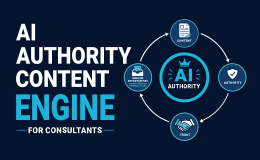
AI Authority Content Engine For Consultants
Build a complete AI-powered authority system that attracts inbound consulting clients without cold outreach or ads.

Instructor
David Tainsh
Course details
Lectures
:
19
Level
:
Beginner
- Description
- Curriculum
- Reviews
Pre-Coure - Before You Start
-
1
 Build Your Knowledge Base
Before you build anything, you load your business into a knowledge base — who you serve, the problem you solve, your offer, your proof, your point of view and your voice — using the setup files provided. Every blog, page and post you create later reads from it, so your work comes out consistent and recognisably yours from the first draft rather than as generic AI output. This is also where your point of view gets written down for the first time, which is the single input that separates authority content from filler. It takes one sitting and it saves you re-explaining your business in every prompt for the rest of the course.
Setup files included: a twelve-prompt interview pack that walks you through each section of the knowledge base one question at a time, the validation prompt that checks it's specific enough to build from, and a completed example knowledge base so you can see the standard before you write your own.
-
2
Build Your Knowledge Base - Live Demo
Step by step walk through installing the knowledge base on Claude.
PART 1 — Content Marketing & Authority Building
-
4
1.1 — Consultant Content Strategy Framework
Most consultant content fails for the same four reasons: no defined audience, no problem focus, no connection to an offer, and no consistent message — which produces attention without conversion. You fix all four here. You define exactly who you serve and who signs the cheque, then map the problem, the pain beneath it, what it's costing them and the outcome they actually want — the raw material for every topic, headline and sales conversation that follows. From that you build the four content pillars — problems, solutions, proof, perspective — that stop you posting at random. You bring the market knowledge and the point of view; AI structures it into a client profile, a problem map and a strategy. You leave holding the foundation layer every other lesson in the course reads from.
Prompt pack included: five prompts producing your ideal client profile, a problem-to-outcome map covering pain and cost, four to six content pillars with themes and example topics, your authority positioning, and a weekly content strategy aligned to your funnel.
-
5
1.2 — AI-Powered Blogging & Content Production System
AI removes writer's block, the time constraint and the bottleneck — and produces content nobody would miss unless you do something about it. This lesson is that something. You learn the structure every high-converting piece follows — hook, problem, insight, framework, next step — and the hybrid model that makes it work: AI handles structure, drafting and speed; you handle insight, experience and positioning. You write for both audiences that now matter, search engines and AI answer engines, which want the same thing from different angles: clear structure and a real answer rather than five hundred words of throat-clearing. You bring the thinking; AI produces the topics, the outlines, the full drafts and the answer-engine pass. You leave able to produce publish-ready authority content on demand instead of once a quarter when guilt sets in.
Prompt pack included: five prompts producing twenty high-intent blog topics, detailed outlines with the questions each piece must answer, full drafts written in your positioning, an answer-engine optimisation pass, and three tiers of call to action from soft to direct.
-
6
1.3 — Content Repurposing & Distribution Engine
AI Prompts and Standard Operating Procedure
-
7
1.4 — Build Workshop — The Content Engine
AI Prompts and Standard Operating Procedure
PART 2 — SEO & Organic Client Acquisition
-
8
2.1 — Consultant SEO & AEO Strategy (Modern Search)
Your buyers aren't searching for you. They're searching for their problem.
Search stopped being one destination. It's now Google results, AI answers in ChatGPT, Perplexity and Gemini, and featured snippets — and the same content has to work across all of them. You start where the buyers actually are: not your name, but how to fix this, best way to do that, this service for my industry. You build three keyword types — problem, solution and service — which together cover the whole buyer journey, then map every one of them to search intent and the page type that satisfies it, because an informational search pointed at a service page converts nobody and irritates everybody. Then you organise them into clusters that build genuine topical depth rather than scattered posts. You bring the market language; AI builds the keyword universe, the intent map, the cluster architecture and the answer-engine rules.
Prompt pack included: five prompts producing fifty keywords grouped by problem, solution and service, a search-intent and funnel-stage map with the right page type for each, a topic cluster strategy with internal linking, your answer-engine formatting rules, and a full search strategy with content plan and execution order.
-
9
2.2 — Authority Pages, Pillars & Service SEO
Most pages chase a keyword and forget the buyer. You build three page types that each do a different job: pillar pages that cover a topic completely and build trust, supporting pages that answer the detailed questions and reinforce depth, and service pages — the ones that actually earn money — which match buyer intent and convert. You learn the structure a service page needs to earn an enquiry: a problem-led headline instead of a job title, a clear outcome, the process explained so it feels real rather than mysterious, proof placed exactly where it reduces the risk of getting in touch, and a next step. Then you connect everything with internal links that move a reader from blog to pillar to service to proof, which improves both what search engines understand and what buyers do. You supply the proof and the offer; AI writes the pages and maps the structure.
Prompt pack included: five prompts producing pillar page content, supporting pages that reinforce it, high-converting service pages, an internal linking map with anchor text, and the complete page system tied together.
-
10
2.3 — Local SEO & Demand Capture System
The easiest high-intent traffic most consultants ignore completely.
Someone searching for an operations consultant in Manchester is not browsing — they are looking to hire, now. Local search has less competition, higher intent and faster results than national search, and almost no consultant bothers with it. You build service-and-location pages that actually rank, which means real local context and relevant local problems rather than a national page with a city name swapped in, because search engines have been ignoring that trick for years. You define the URL structure, the content sections and the authority signals, then set up the rollout that lets you expand across locations without producing twenty near-identical pages that get filtered out. You choose the markets; AI produces the keywords, the pages and the scaling system.
Prompt pack included: five prompts producing your location keyword strategy, location pages with localised messaging, a local page structure covering URLs and sections, local authority and trust signals, and a rollout plan for scaling across markets without duplication.
-
11
2.4 — Build Workshop — The Search System
The build session for Part 2. Fifty keywords generated, grouped, mapped to intent and clustered on screen — including the ones that look sensible and are worthless, and the judgement call that removes them. Then a pillar page and a service page produced end to end, with the service page coming back generic on the first pass so you can see exactly which input caused it and what turns it into something that reads like a consultancy rather than a template. Finally the first location page built properly, plus the rollout logic that stops pages nineteen and twenty becoming thin copies of page one, which is where nearly every local attempt quietly dies.
In the workshop: all fifteen Part 2 prompts run in order, from empty keyword list to a page architecture you could publish.
PART 3 — Personal Brand & Thought Leadership Platform
-
12
3.1 — Consultant Positioning & Personal Brand Strategy
Your brand is what people believe about you when you're not in the room.
Not your logo, not your colours, not a tidy profile. If you aren't positioned you compete on price, sound like everyone else, and attract exactly the clients you didn't want. You fix that with four answers that have to be instantly clear: who you help, what problem you solve, what result you deliver, and how you're different. Then you pick your authority angle — specialist, method-based or outcome-driven — because generalists don't build authority, they build a long list of things they'll consider doing. You write the story that shows why you understand this problem and how you arrived at your solution, and you assemble the credibility that makes it believable. You bring the experience and the results; AI turns them into a positioning statement, an angle, a messaging framework, a founder story and a proof stack that later feeds your service pages and your profile.
Prompt pack included: five prompts producing your positioning statement, your authority angle, a messaging framework with the themes you repeat everywhere, your founder story from origin to transformation, and a credibility stack of proof points and results.
-
13
3.2 — LinkedIn & Social Authority System (AI Prompts)
LinkedIn gives consultants direct access to decision-makers with organic reach no other platform matches, which is why this lesson treats it as an authority channel rather than an outreach channel. Your profile has to state what you do, who you help and what outcome you deliver, because people decide in seconds and a CV loses them. Your posts have to be insights, mistakes, frameworks and contrarian views rather than generic tips, and every one of them lives or dies on the first line. You build the posting rhythm that creates familiarity, the engagement habits that turn readers into conversations, and the path from post to reply to call. You supply the point of view; AI generates the profile copy, thirty post ideas, the drafts and the schedule.
Prompt pack included: five prompts producing your optimised headline and About section, thirty post ideas drawn from your problem map, written posts with hook, insight and next step, an engagement system covering comments and replies, and a posting schedule you can actually keep.
This lesson builds LinkedIn as an organic authority channel. For outbound — connection requests, message sequences and automation — see the AI Powered Consultants LinkedIn Lead Machine.
-
14
3.3 — Thought Leadership & Audience Growth Engine
Thought leadership isn't posting more; it's sharing original thinking and leading the conversation instead of joining it three days late. You build the ecosystem where that thinking compounds — LinkedIn for visibility, email for nurture, search for discovery — with every channel feeding the others rather than running as three separate hobbies. Critically, you build an audience you own: platforms change their rules without warning and a list is the only asset that survives that. You create the authority assets that make you the expert rather than someone with opinions — guides, frameworks, insights, reports — and the conversion path that turns an audience into conversations and conversations into clients. You bring the original thinking; AI produces the topics, the deep content, the newsletter system and the growth plan.
Prompt pack included: five prompts producing your thought leadership topics, deep authority content built on your own frameworks, a newsletter system with format and frequency, an audience growth strategy across channels, and an inbound conversion path from reader to enquiry.
-
15
3.4 — Build Workshop — The Personal Brand Platform
Positioning sharpened, profile rewritten, audience layer assembled.
The build session for Part 3. You watch a positioning statement come back true but forgettable and see exactly what changes to make it land, then the founder story built from raw career facts into something that earns trust rather than listing jobs. The LinkedIn profile gets rebuilt line by line and a week of posts taken to finished drafts — including the ones that read like AI wrote them, why they read that way, and what fixes it. Then the newsletter system and your first authority asset, wired into the conversion path so a subscriber has somewhere to go when they're ready to talk.
In the workshop: all fifteen Part 3 prompts run in order, from positioning through to an owned audience with a route to a conversation.
PART 4 - System Deployment
-
16
4.1 — Master Prompt & System Rebuild
Rebuild everything in one run, whenever your market moves.
A single master prompt that reads your knowledge base and every asset you've built, and produces the entire authority engine in one execution — positioning, content strategy, blog engine, repurposing, distribution, search strategy, authority pages, local pages, LinkedIn and audience growth. Use it to build fast if you'd rather not run the packs individually, and to rebuild whenever your offer, niche or market shifts. This is what stops the system going stale a year from now, when your positioning has moved on and your content hasn't noticed.
Prompt pack included: the master prompt and its compile step, producing the complete authority engine in one run.
-
17
4.1 — Demo — Rebuilding the Engine
The whole system regenerated, and the half of it worth ignoring.
The rebuild session for Part 4. Priya raises her fee and lifts her client floor, and you watch what that actually breaks. The knowledge base gets updated first — because a rebuild is only ever as current as the file it reads — then the master prompt runs all four phases in one sitting, including the six gaps it marks and refuses to fill in. Then the diff against the previous version: eleven material differences, seven of which turn out to be the model rewording something it already agreed with. You see exactly how the four that mattered get separated from the seven that didn't, and why the pillar page that was working gets left completely alone.
In the demo: a full rebuild from trigger to adoption, with the cosmetic changes discarded on screen.
-
18
4.2 — Individual Task Prompts
Operate the system without regenerating it.
Your control panel: short, single-job prompts that display, verify and pressure-test any part of what you've built. Show me my content pillars. Show me my keyword clusters. Show me my positioning statement. Check whether this draft actually says anything a competitor couldn't have written. You run the system from these day to day, and you use them to find what's weak before it costs you a reader — which is considerably cheaper than finding out from the silence.
Prompt pack included: the full library of single-job activation prompts, grouped by system.
-
19
4.2 — Demo — Running the System
Ten minutes a week, and the questions nobody enjoys asking.
The operating session. The weekly four run first — what's overdue, what to write next, last week's drafts checked, the repurposing queue — so you can see how fast a read-only prompt answers when the knowledge base is properly loaded. Then the monthly review, where it gets uncomfortable. The drift check reads a month of published posts and quotes back three lines where the positioning quietly widened without anybody deciding to. The competitor test runs on the best-performing piece rather than the worst, and comes back with nine sentences anyone could have written against four only Priya could.
In the demo: both routines run end to end, including the drift nobody had spotted and a [VERIFY] tag still live after four months.
Please, login to leave a review